In this issue:
- From the chair
- Bazalgette Embankment opens in London
- Deptford Creek
- A walk from Waterloo Station to Borough Tube Station
- Rail 200
- The mystery of Bopser
- Barking Dockland
- Railway surveillance
- Kenley
- News in brief
- Tracking the Heritage
- Ladykillers' locations — 70 years on
- Books
- 342news.pdf
By the time this reaches you we will have held the first lecture of the 2026 series, do keep an eye on the website and Newsletter for the future dates.
On 25 April we will be hosting SERIAC 2026 at Stanley Arts, South Norwood. Admission to the day is by ticket only with options for a snack packed lunch and limited car parking. Please use the link to book via Eventbrite (https://tinyurl.com/SERIAC-2026).
We have a couple of jobs on the day from registering attendees to helping with the car park, do get in touch if you can help.
Best wishes for 2026. Dan Hayton
Bazalgette Embankment opens in London
London has a new monument to Sir Joseph Bazalgette, the engineer who designed the sewer system for the Metropolitan Board of Works following legislation in 1858.
The Bazalgette embankment is the platform at the top of one of the access points that Thames Water used to construct the 25km Tideway Tunnel (GLIAS Newsletter November 2020), designed to capture overflowing sewage between Acton and Abbey Mills so it does not run into the river.
Architectural writer Hugh Pearman calls it 'a fine new piece of public space', which marks the junction of the old River Fleet, which used to empty into the Thames, with the sewer. It is easily accessible, being on the Victoria embankment, built by Bazalgette himself back in the 19th century, and is just 150m upstream of Blackfriars underground and Thameslink stations.
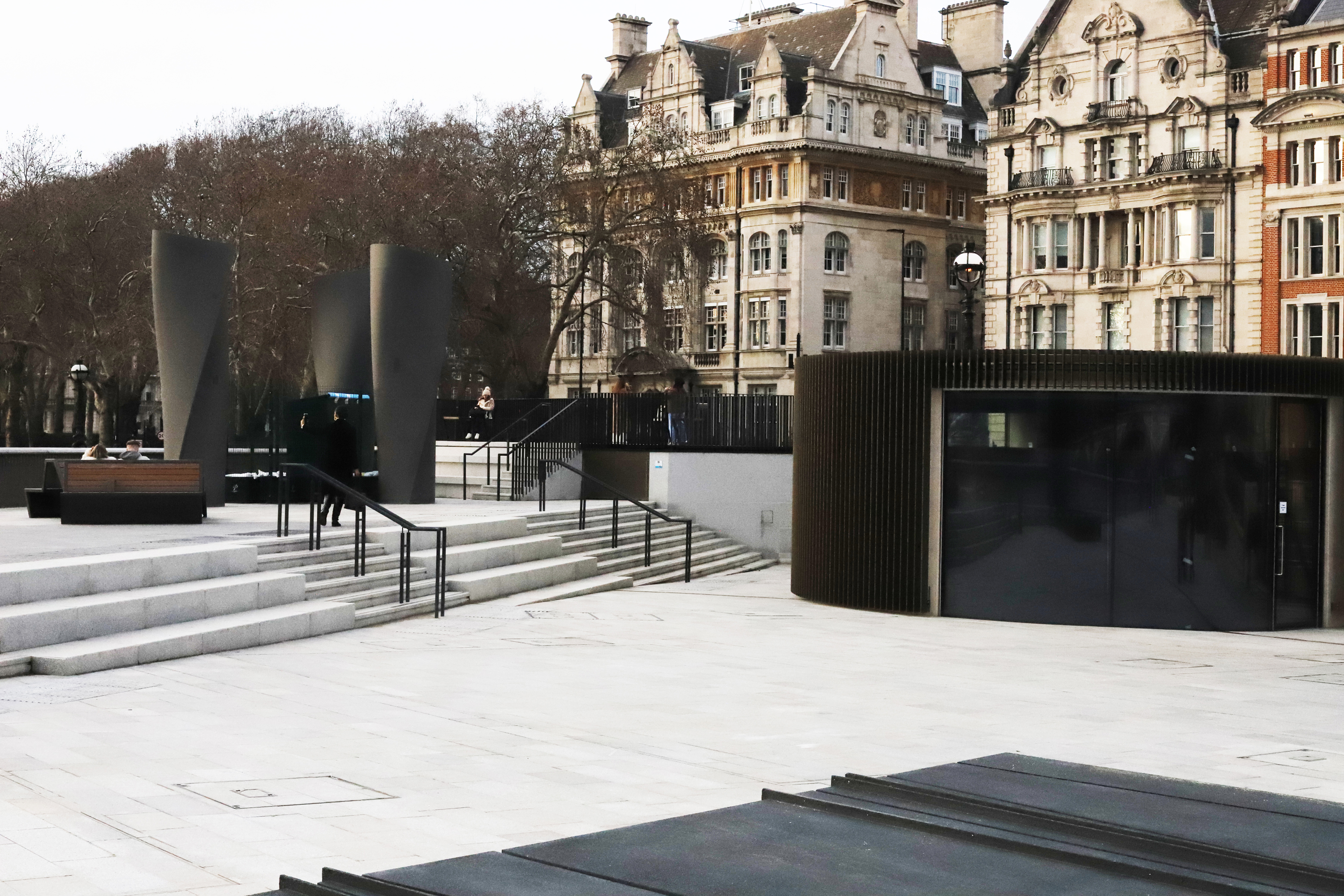
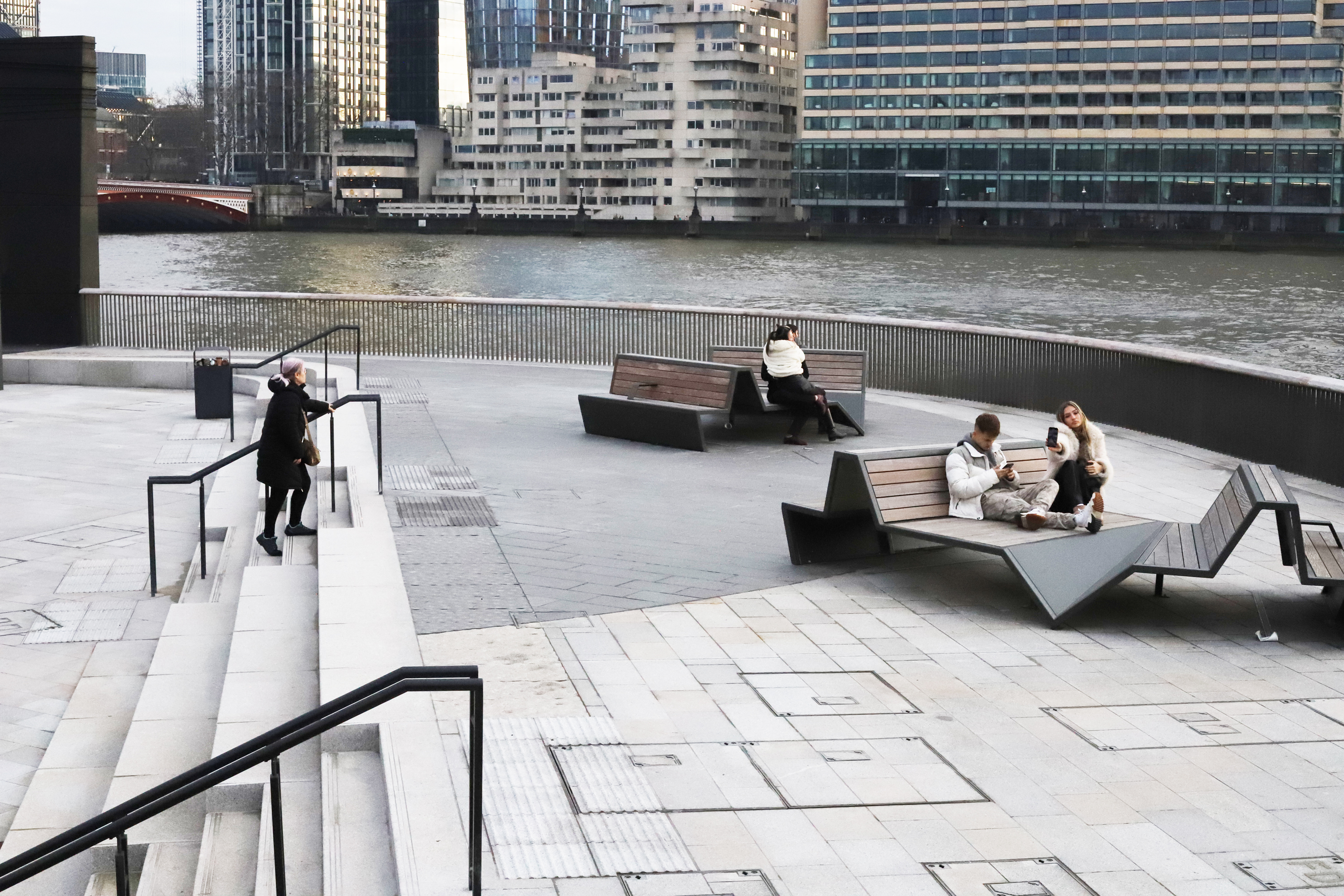

On a sunny Sunday afternoon in January the new embankment had walkers, smooching couples, skateboarders and others just enjoying the view of the river. It is connected directly to the footpath along the Victoria embankment at both ends, with a lift and steps to and from Blackfriars bridge. And you can see the underside of the bridge, where in 1982 Italian banker Roberto Calvi was found hanged — apparently the result of a Mafia killing, though after a trial in Rome five people were acquitted. Alan Burkitt-Gray
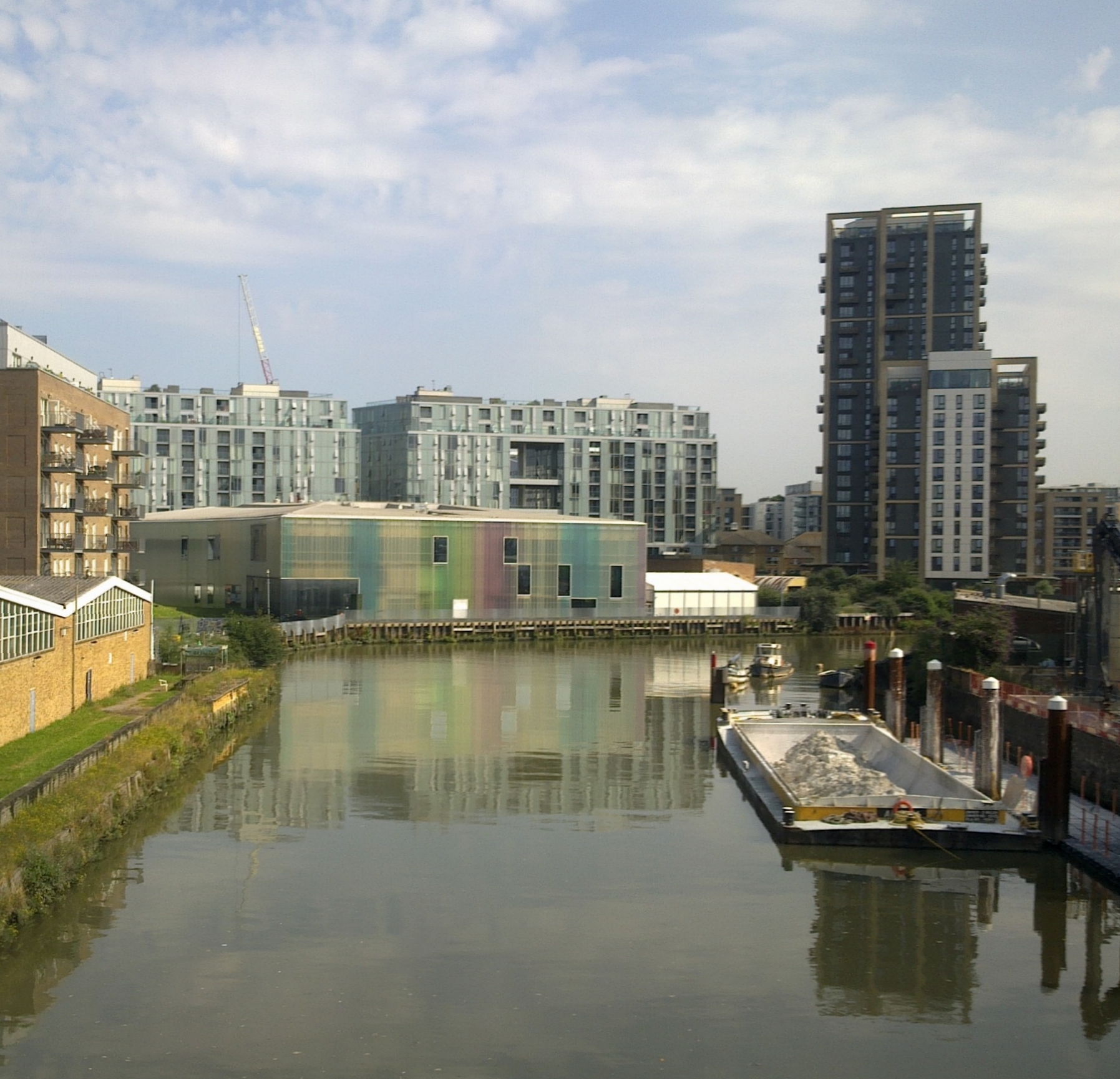
This photograph taken in July 2021 shows the view looking north from the railway bridge towards the River Thames. On the bottom right of this photograph is Phoenix Wharf being used to load barges with spoil to be taken away. This spoil came from construction of the Thames Tideway Greenwich Connection Tunnel which was completed in August 2023. Brewery Wharf (GLIAS Newsletter December 2025) is to the north out of sight round the bend in the Creek. Bob Carr
A walk from Waterloo Station to Borough Tube Station
This walk is about 2 miles and, with pauses, will take around 80-90 minutes. It includes some general and social history
From Waterloo main line station take the escalator opposite Platform 4 to Waterloo Rd. From the Underground, take the Jubilee line exit to Waterloo Rd. Turn right. The LCC Fire Station, opened 1910, now a bar, had residential accommodation for some officials and firemen and their families (seven families, two bachelors in 1911 census). It became LCC Ambulance's HQ in the 1950s until new, larger, premises were opened for the (since 1965) London Ambulance Service.
Continue to the junction with Baylis Rd. Diagonally opposite is the Old Vic, an 1871 rebuild of a smaller original theatre. The six-column replica canopy was erected about 40 years ago. Continue, passing, on the other side of the road, the stone façade of the 1928/30 HQ, with the Scottish thistle, the firm's emblem, of David Greig Ltd, a chain of grocery shops which never made it into the supermarket era. Their premises included that site now occupied by the Hampton hotel. Go ahead, across Pearman St and up the steps in front of London Ambulance Service HQ, opened 1973. Past the entrance is a small garden with a memorial to ambulance workers who died in the Second World War. (Photo 1). Turn left, down the steps and right to continue along Waterloo Rd. Opposite, on the corner, Travelodge occupies St George's House, built c.1936/7 as offices to rent. Ahead left, is the road frontage of Nos. 215-233, Mawdley Buildings, a 1905-6 LCC block of flats with shops below, and further blocks off Webber Row behind. Cross the road, turn right and continue.

-
1. Memorial to ambulance workers
Opposite, Nos. 256-260, was built in 1922 as workshops for blind people. Cecil House, no. 266, was, despite appearance, built in 1934, and opened by the Lord Mayor of London, as a refuge hostel for 49 vulnerable women (the fourth in London with that name and function). The 1939 Government Review lists 42 women, which includes the staff. It closed in 2023, but No. 259, Northcote House, a bit further along on the left, built in 2001 by the (same) Central and Cecil Charity, has a similar function.
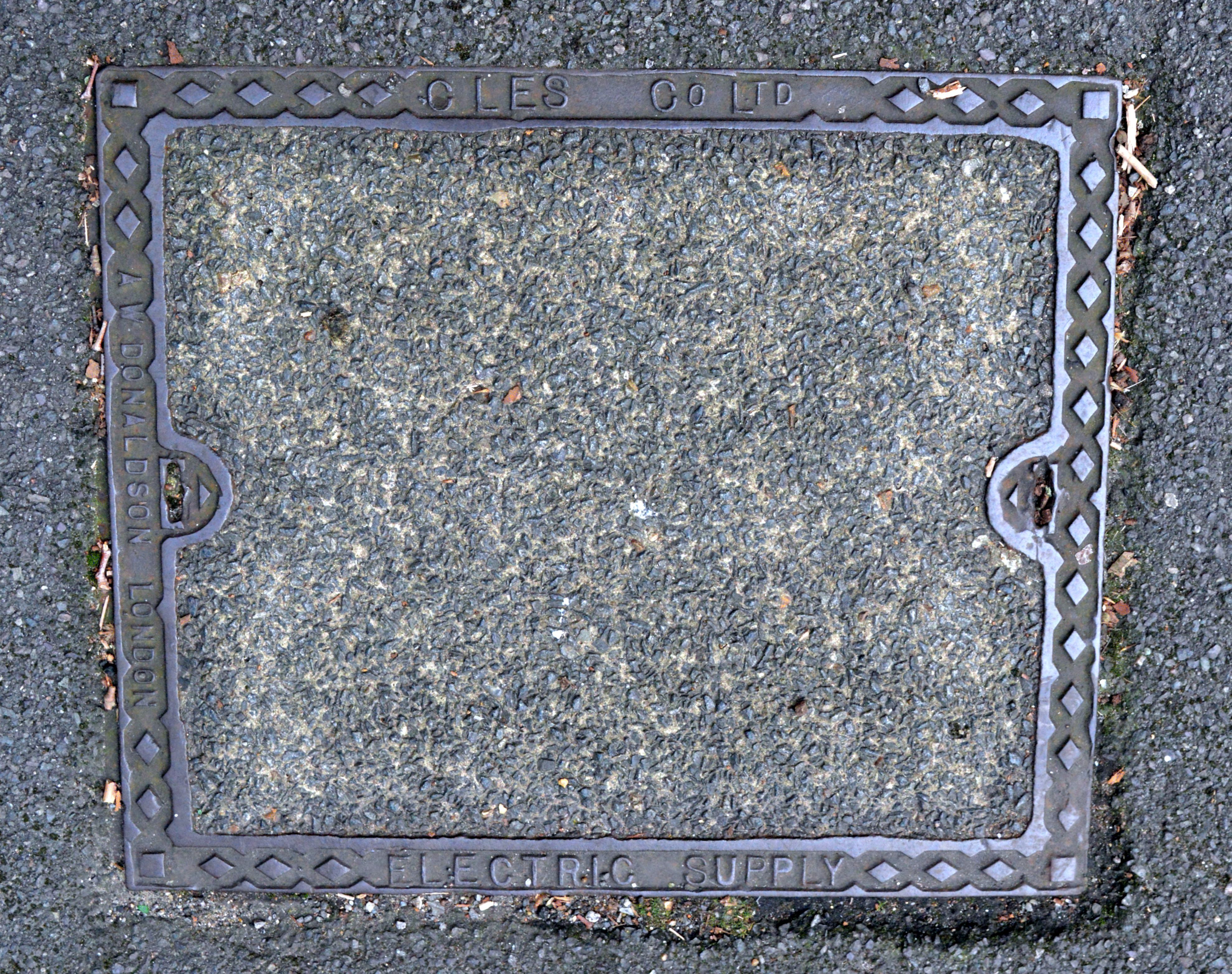
Going forward again, check the pavement shortly after the bus shelter, where there is a metal-with-concrete cover inscribed 'CLES Co Ltd Electric Supply' — the County of London Electric Company. (Photo 2). Its predecessor was founded in 1891, this cover dating from between 1904 and 1948, when the Company was nationalised as part of London Electricity. By the 1930s several companies were already co-operating and sharing power station supplies. About 10 paces further, before the traffic lights, is a second similar cover, London Electric Supply Corporation. Established in 1887, it built, and received supply from, Deptford power station.
-
2. CLES Co Ltd Electric Supply cover
Pause to face the dark brick building almost straight ahead, 5 Westminster Bridge Rd, then cross Waterloo and Westminster Bridge Roads to note the small white stone on No. 5 at ground level. It is marked with a cross, date 1899 and letters AMDG — for 'Ad Maiorem Dei Gloriam', translated as 'For the glory of God', often on Jesuit schools, as this once was. Turn left, to look round St Georges Circus, a planned junction of five new roads all built 1768/71, with the obelisk erected in 1771. In (say) 1920 there was a mass of tram lines, as each road had them. Now look right, along Lambeth Rd. Behind the long wall, topped with railings, is the roof of a building over four lines of London Road Bakerloo Line depot; a further six are in the open. Cross the road and bear left to pause before crossing London Rd. Ahead is the former Duke of Clarence PH, flanked by houses with ground floor shop frontages re-antiquitised. All are now part of the ever-expanding London South Bank University (LSBU hereafter). Cross Lambeth and London Roads and turn back to the look at the nondescript brick building. Alongside is the pedestrian entrance to the underground depot. The grill instead of a window is for exhaust for a fan venting the tunnel below.
Go forward a few paces into Borough Rd, stopping outside the second and third non-doors for a further pavement cables junction box, for London County Council Tramways. A few steps forward, outside the seventh door, is a further, different, cover, lettered 'CL&BP EL Co Ltd' — the City of London and Brush Provincial Electric Light Co., formed 1891. (There are more later, but that's enough!)
Stop a few paces on, at the next road, appropriately Rotary St. Facing Borough Rd, with empty land behind, Nos.109 to 112, is the façade of the first Presbyterian church south of the river, opened 1846, capacity 800 worshipers. It closed for worship in 1901, and was purchased and repurposed as a factory by R Hoe & Co.
Hoe was born in New York to English immigrant parents. Hoe senior invented a rotary printing press and his son joined the business. After exporting well-received machines to England, 1856-60, Hoe junior set up a London office and a factory near Fleet St. The manufacturing soon moved to Walworth. That expanded to occupy several sites before being consolidated here as A Hoe & Co, combining in 1920 with Crabtree. The firm gradually diversified into other metal products, and became part of the Vickers Group. This site is shown in the 1981 Kellys as Crabtree-Vickers, printers' engineers. It closed that year or shortly afterwards, with work transferring to Newcastle. In January 2026 the (listed) façade, plus open land behind, has been in limbo for many years awaiting development as part of LSBU. (Hoe at its peak also occupied another building, seen later).
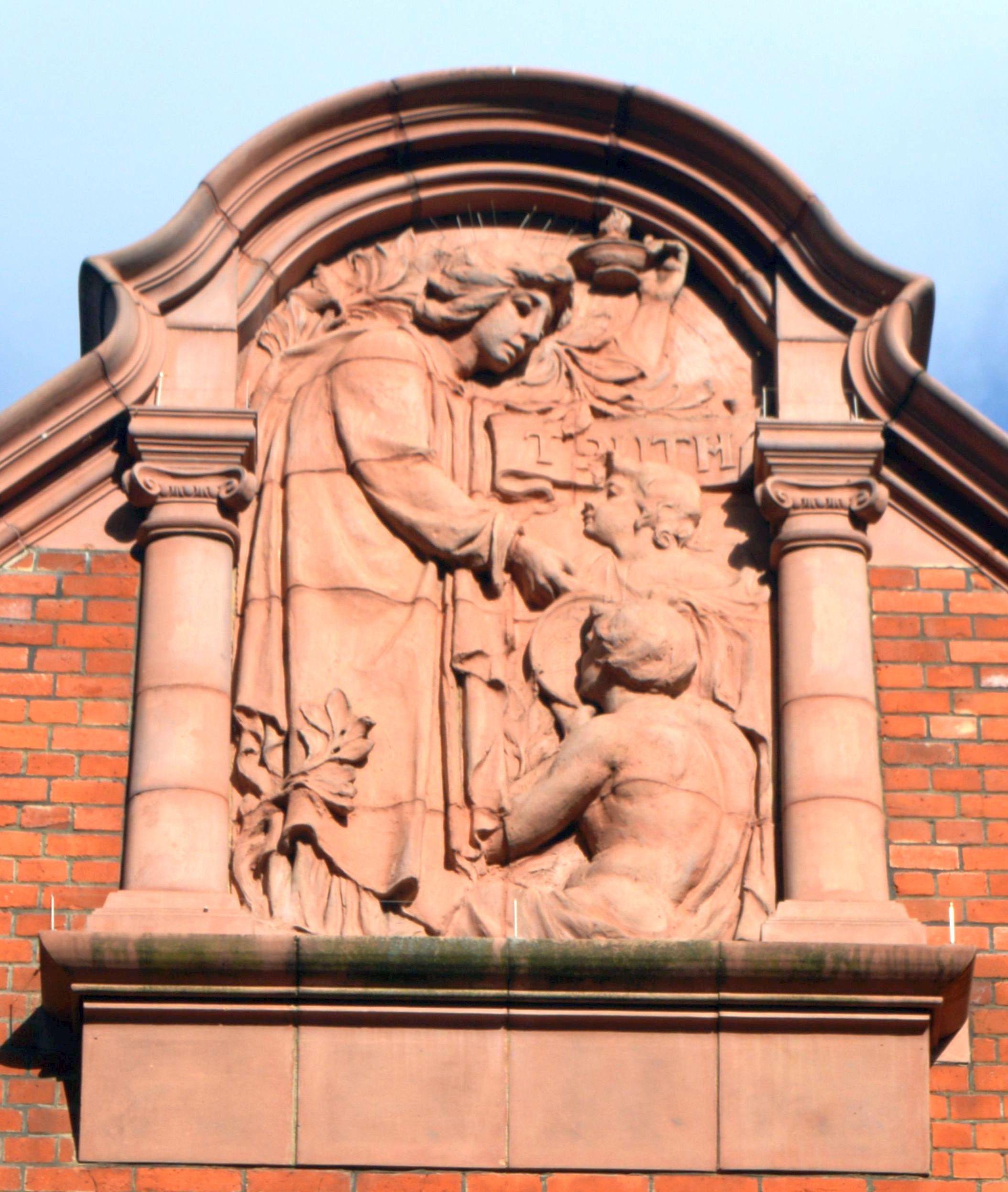
Across Borough Rd is The Passmore Edwards Library, one of 16 in London which he funded. Opened in 1898 by the man himself. Go forward to the left side to see the panel, 'Truth' holding the lamp of learning — but not a book in sight! (Photo 3). Then to the front. Top is a horse-backed St George lancing a dragon. Both sides of that are symbols. Left is the cross of St George. Right represents two things — the Bridge House Estate charity and the parish of St George the Martyr. A large area within the parish was benefacted to the Estate, initially set up from 'old' London Bridge tolls profits, and its symbol came to be used to represent the parish as well as the Estate itself. That was administered from Bridge House, located at the south end of London Bridge, hence the name. The building is now part of LSBU.
-
3. 'Truth' holding the lamp of learning
Continue east along Borough Rd. Next on the left is the modest former HQ of NATSOPA, c.1920, perhaps not as well recalled as SOGAT, with which it merged in 1982, before that in turn became part of the Graphical, Paper and Media Union in 1991. The building became another LSBU adage.
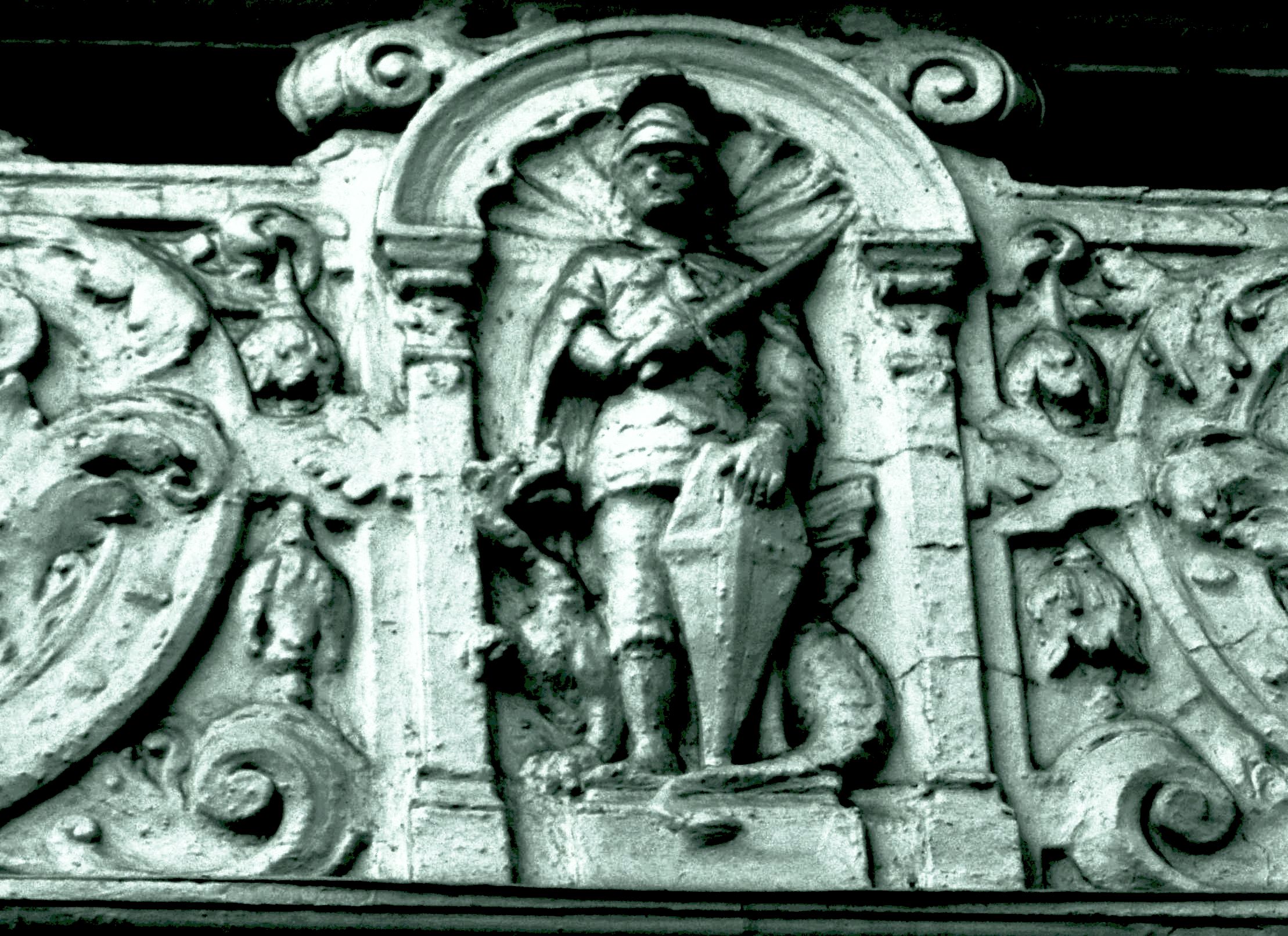
Next are blocks of flats around a courtyard. Circumnavigate them by turning left into Milcote St, then right into King James St, to see they were built by the LCC in 1899. The previous properties here were demolished under the 1890 Housing of the Working Class Act. (The LCC was set up in 1889). Go on and turn right into Lancaster St, then right again to see the street side of three blocks of Murphy House. Decoration on each is a figure with a shield and sword (two male, one female) — do they actually represent anything? (Photo 4). The other side of Borough Rd has several phases of LSBU buildings. The site has a long educational history, starting as a school for poor children by a Mr Lancaster in 1827, evolving and growing in scope, becoming a Polytechnic in 1882 and gaining University status in 1992. Below the now-familiar symbol above the main door is the urge 'Do it with thy might'.
-
4. Murphy House decoration
Go back across Borough Rd and turn right, towards the railway bridge. Passed on the left, about 6 ft above ground level in a blank wall, is an oddly placed 1992 'foundation stone'. Mr Seitz, the American Ambassador was at the time a 'big cheese', with multiple directorships in the UK, including Lehman Bros. But I have not found whence it came and why now here.
Stop under the railway bridge — it's two separate bridges of different styles, side by side, approached on both sides by what appears to be a wide four-track brick viaduct. It is actually two adjacent and aligned viaducts. The London Chatham & Dover Railway opened a two-track line in 1862, on viaduct from Camberwell to the Thames. At that time their bridge across the Thames had not opened. Two more tracks were soon added by building a second viaduct, arches aligning, opened in 1864. With a Thames bridge completed, the line joined the Metropolitan Railway at Farringdon, and thence connections to the lines of the Great Northern and Great Western Railways lines. Standing beneath the two bridges, notice they are not actually parallel — there is a gap between them at the north west end. This is because not far beyond was Borough Road station, with four platforms, two of which were in the middle. Reached by steps from Belvedere Passage, it was for passengers only and closed in 1907. Nothing remains.
Onward, across Southwark Bridge Rd, Nos. 47/8, The Duke of York, became the independent Goose & Firkin in 1979, brewing on the premises, the first in London of several similar 'Firkins'. 'Dogbolter' was the main beer. It ceased brewing in 1999. Beyond, nos. 49-60 was a large factory, the works of Day & Martin, blacking manufacturers. Charles Day and Benjamin Martin began manufacturing in High Holborn in 1801 and the firm moved to these new larger premises in 1889. By 1904 there was a range of over 80 products including all types of polish. (The GLIAS database mentions a chimney, now demolished). The company moved to Stratford in about 1919 and ceased to be independent in 1925, but the name continues, marketing equestrian products. Cropper & Co Ltd, folding box manufacturers, moved in, then a few years later the premises were taken over as additional works by Hoe.
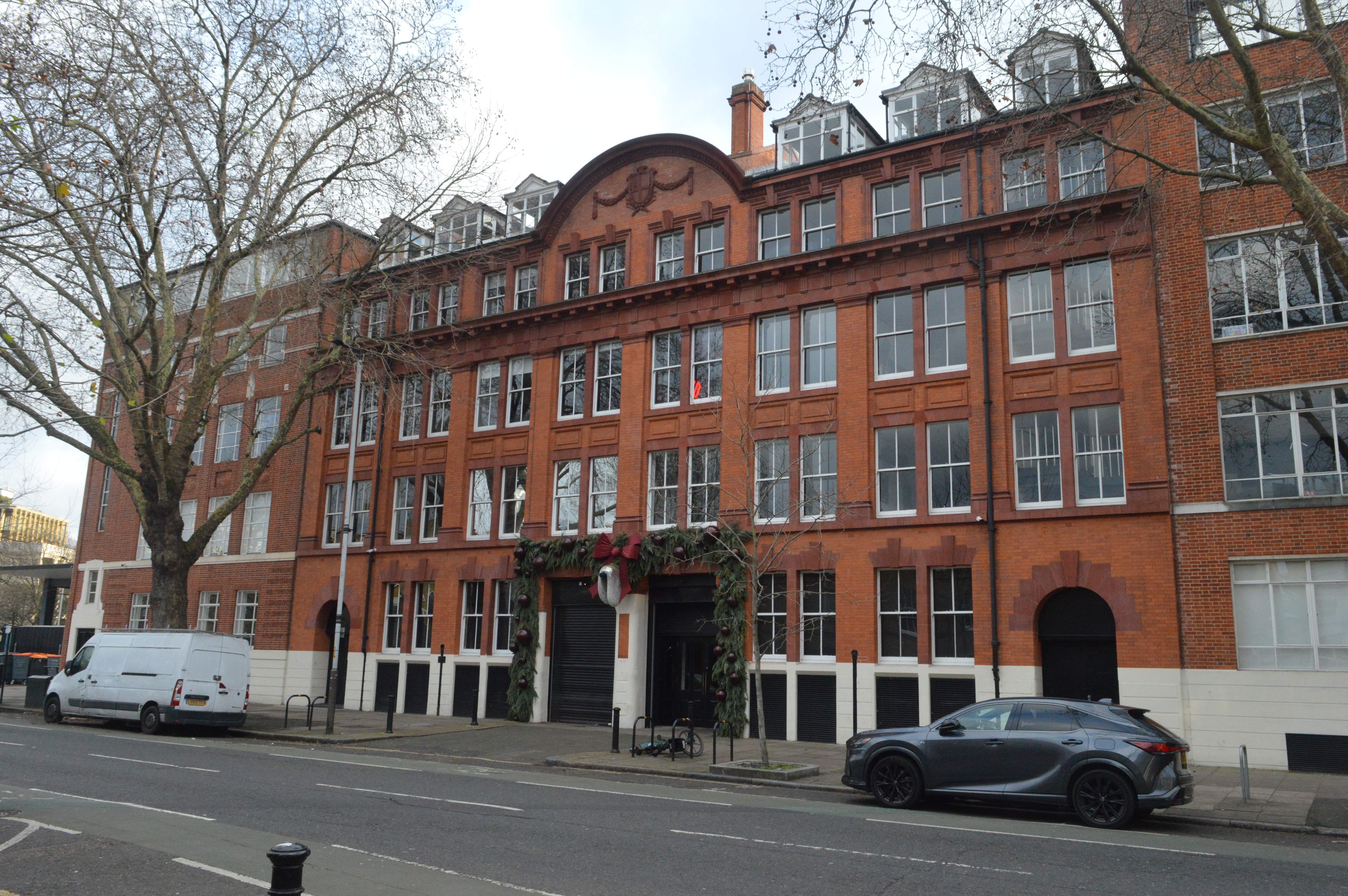
Opposite are several buildings which are likely to disappear in part or completely in development by Berkeley Homes of a large site, acquired in 2020 and for which planning permission has been granted. (Photo 5)
-
5. Borough Road Nos. 83 to 74
No.83, although adorned with two stone crosses, was not a place of worship but the South London Institute for the Blind. A foundation stone appears to be dated 1886, though different dates are quoted. Maybe there was a religious influence, as the last name on the stone is Rev. St Claire Hill, the Association's Secretary. It later became St George's National & Parochial School and then a Barclays Bank.
No. 81 is a former Baptist Chapel, boarded up in January 2026. To its east, Nos.74-79 was single entity, comprising an older building with the City of London shield (St George cross with one in the top left) above, and additions either side — that to the left is dated 1934. This site, plus buildings behind, was, from at least 1890, the office and manufacturing site, of James Lillywhite, Frowd & Co. William Lillywhite set up the firm c.1850 to supply cricket wear and expanding to include bats, wickets and balls, before extending the range to other sports, including tennis, croquet and football. The centre building was later named Diary House, as from 1920 these premises included some, then from 1934 all, of the printing works and offices of Letts. In 1796 John Letts opened a printing, stationery and book binding shop and in 1820 produced the first commercial diary, a product for which the firm was widely known, although there were many more, including account books, calendars and carbon paper. They moved out in 1980, but their name remains as part of the portfolio of the FLB Group (initials for Filofax, Letts and Blueline), based in Dalkeith, Midlothian. Just beyond the end of the Day & Martin works, No. 61 is an octagonal building, joined to others. It was built in 1821 by stone mason Henry Hartley, with a works yard, hence current names of it and No. 63.
Cross Borough Rd, turn left, past a garage forecourt, then cross Newington Causeway and turn right to stop outside the gates of Inner London Crown Court. The main building is of 1920 with later extensions. The emblem on the gates is of the LCC, which ceased being used when that became part of the GLC, though is now (announced 2025) to be revived. Being above the Northern Line, it is likely that the ventilator inside the grounds to the left is for that, below, but it's only a guess. Across Newington Causeway the open land owned by Berkeley Homes included Lillywhite and Letts workshops.
Turn back, north, along Newington Causeway, crossing Harper St, continuing on what becomes Borough High St. The police station of 1938, with additions, is on the site of one of the south London Civil War forts. The emblem, above, incorporates elements of the royal insignia, with a portcullis and two lions each holding a gold column (the column reflects authority, or law and order).
Continue to take the next turning right, onto the south pavement of Trinity St. This is named after a different bequest by Christopher Merrick, Merchant, of land to Trinity House, as of lighthouses, etc. around the British Isles. It was developed from c.1820. A wall on the right, just beyond Swan St, has their estate ownership coat of arms (four ships). Cross Trinity St, and retrack to go right (north) along Swan St and soon right into Cole St. The south side has a clutter of industrial buildings of 1870+ with a few original 1820s houses sandwiched between. This would have been a typical scene in many streets hereabouts. The church-like façade towards the end was just that once — once Holy Trinity Baptist Chapel. Go to the end and turn right into Globe St. The corner building was Wallin's tin box works, converted about 25 years ago into apartments (with an additional storey added to one part) (Photo 6). Their office was on the corner of Trinity St and their original nameplate survives. On reaching Trinity St again, turn right to the corner of Trinity Square, developed to a relatively uniform style by different builders in the period 1815-35. Holy Trinity Church, 1824, never as parish one, became the (BBC) Henry Wood Recording Studios in 1975, now with some alternative uses as well. The still-crisp upper part of the statue in the garden, allegedly of King Alfred, is a Coade stone re-creation.

-
6. Part of Cole St
Turn back and continue along Trinity St. A narrow cul-de-sac on the right, Redford Row, has a terrace of 10 newish houses on the site of a former pickle works, as are the next terrace on Trinity Rd. After passing the last one, No. 7, look back to the right to see a surviving fragment of the factory wall. Continue alongside Merrick Square to the junction with Falmouth Rd and turn the corner to see the former Dispensary building on the right. 'Listing' includes the words. This was a charity for distributing medicines to the poor. Turn round, pass the Roebuck PH to look, across the site of a turnpike gate, at the brick building on the other side of Great Dover St (named after the landowner, not a destination). Either side of the entrance are two figures in relief depicting once-time activities within. (Photo 7). This, the 1897 HQ and works of Dewrance & Co, included a brass foundry and machine shop. The firm, started in the 1840s, specialised in fitting for boilers and steam engines. They moved to this site in 1897, expanding to cover land either side and behind. Taken over by Babcock & Wilcox, by the 1980s the site ceased to have an industrial purpose. Extensions were demolished and replaced by flats whilst this building is now a student residence.

-
7. Worker, Dewrance & Co
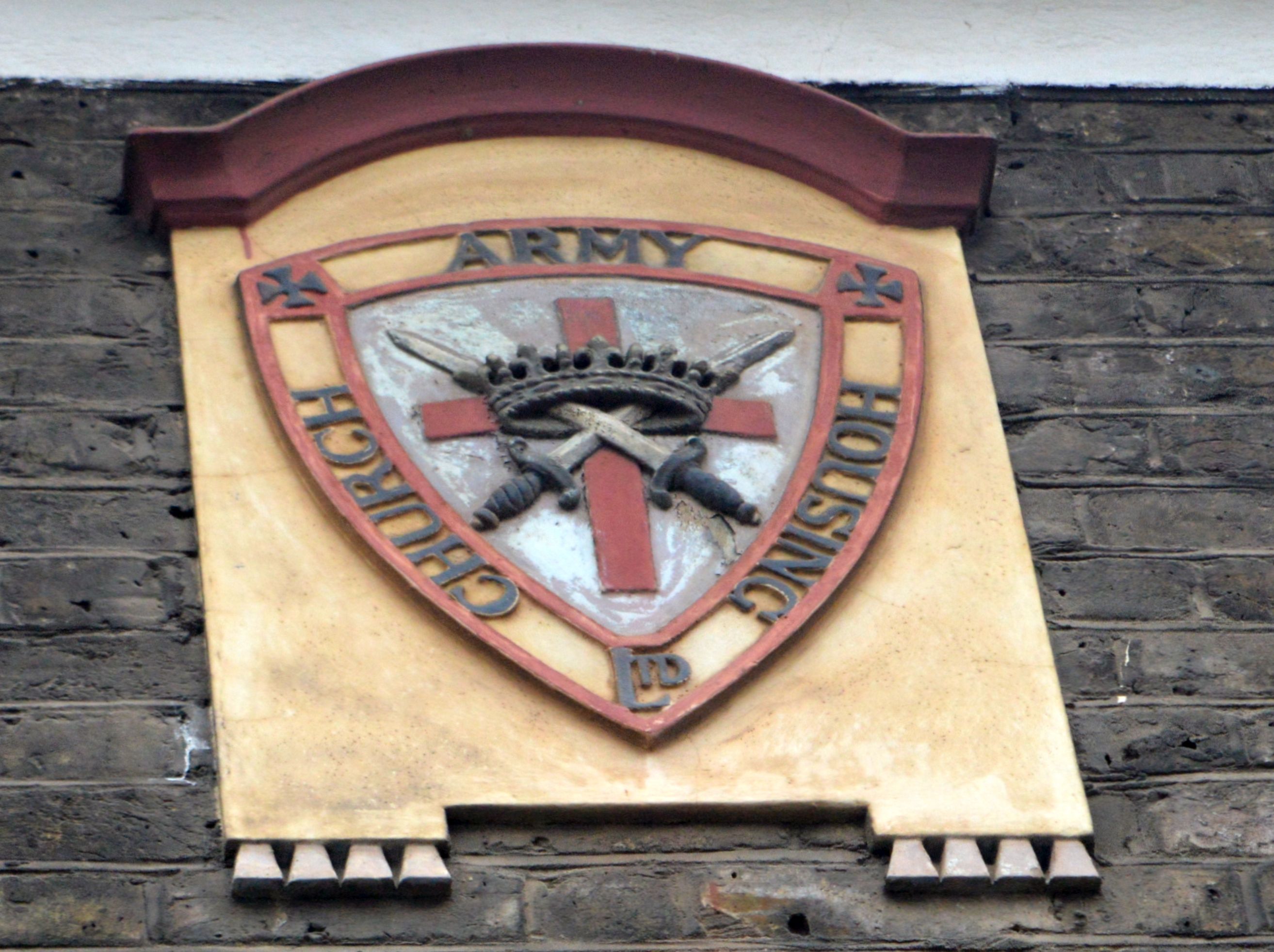
Turn left and take the first turning to the right into unnamed Becket St and left into Tabard St. On the right, the park is part of a large-scale LCC plan, started in the 1920s. Continue. On the left is an almost complete run of railings made from metal former civil defence (emergency) stretchers. On the left, across Pilgrimage Street, is mid-1930s workshops and factory for Down Bros Ltd, manufacturers and suppliers of surgical instruments and accessories to hospitals throughout the UK and Colonies (Photo 8). They previously had offices in St Thomas' St, opposite Guys Hospital, with workshops close by. Now Victoria College of Art & Design. Continue to Elgood House, on the corner of Nebraska Street. This, containing nine flats, effectively social housing, was built by the Church Army. Around the corner, above is their emblem, reflecting their Telegram address — BATTLEAXE. (Photo 9). They continue to provide housing — there are a few other Elgood House in London — plus (like the Salvation Army), a range of social and welfare activities. Elgood was the Chairman of Church Army Housing Ltd.
On the opposite side of Nebraska Street is the rather glum 1935 brick HOP telephone exchange.

-
8. Former Down Bros Ltd factory; 9. Church Army emblem
Return to Tabard St and continue. Soon, there is a doorway on the left with dates 1611, 1885 and 1935. It is now a school, but was part of Charterhouse Charity, started in 1611, with premises built here in 1885 and rebuilt 1935. The hound replicates the founder's hunting dog.
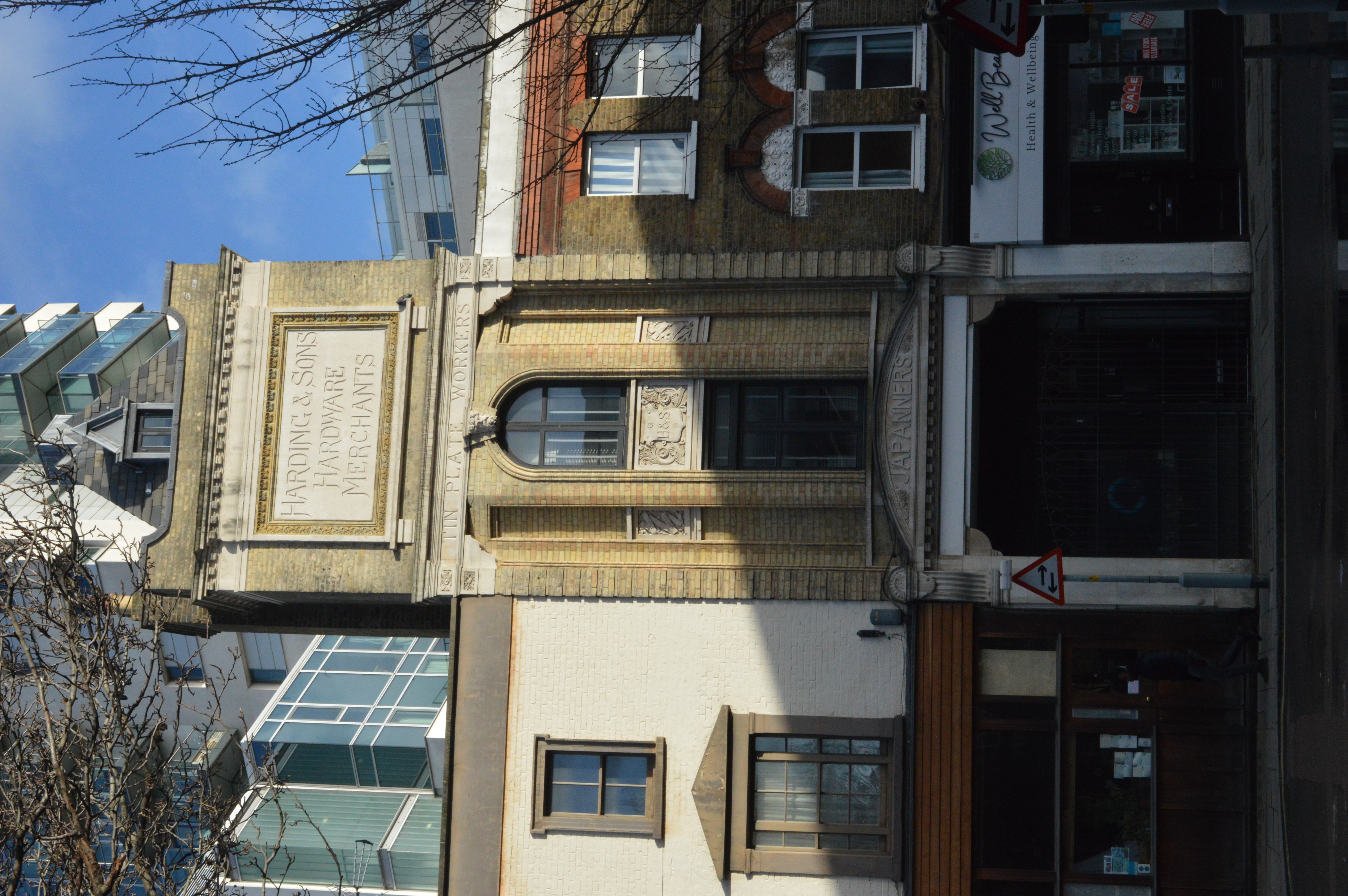
On the other side of the road, opposite the end of Silvester St, is the ornate frontage of a building with former vehicle entrance. Wording among the ornamentation showing it was a metal works of Harding & Sons (Photo 10). Behind was a yard with several buildings — and more along both sides of Long Lane. All except this one have gone. It is now offices with a modest back extension.
-
10. Harding & Sons, Tabard St
Continue past the funky 'Tabard House' (space to rent) and cross Long Lane, continuing in the same direction on a pedestrianised area, then right through the gate of a small park. As indicated by the small mounds of broken gravestones just inside the gate, this was the church's graveyard. Turn right, towards the small building, vaguely like a small church hall. This was the Coroners Court for the post-1899 Borough of Southwark. The coat of arms represents the Borough's four constituent parishes. Clockwise from top left: St Saviours (rose), St Mary Magdalen (lily), Christ church (stag head) and St George the Martyr, with, below, 'United to Serve.' It is still in use, now accessed from Tennis St. Turn left towards the tall brick wall, once surrounding Marshalsea Prison (closed 1842) and follow it round to a gateway into a narrow alley. Turn left, alongside the dark-brick wall of Southwark Archives and John Harvard library, to Borough High St. On the immediate left is the façade of the former Crown PH and beyond the portico columns of St George the Martyr parish church, opened 1736, on the site of a smaller one and repaired after Second World War damage. On the street corner diagonally left is Borough tube station, Northern Line, opened in 1890 on the City & South London Railway. The narrow tunnels from here to the terminus at King William St (near Bank) were abandoned and replaced by new, larger, ones in 1922, when this became a part of the Northern Line, City branch. Part of the station itself was rebuilt in 1922 and again in part in 1985 when new lifts were installed, the street frontage receiving a new cladding of tiles. The disused tunnels remain and were used as air raid shelters in the Second World War, with several access points along Borough High Street. But that's another story.
Thank you to the helpful staff at Southwark Archives, where Kelly's Directories, Rate Books, GOAD plans and publications on the area, were looked at. There has also been much reliance on internet information. David Thomas
On Network Southeast a Networker train unit 465908 has been restored to Network-Southeast livery and given the name Chris Green OBE. In June 1986 Chris was the founder of networks as a business sector within British Rail which changed how railways in Southeast England operated and created an instantly recognisable brand. Signs of this branding can still be seen at some stations.
Rail networking is the system of interconnected railway lines, involving the ownership, operation, and maintenance of this infrastructure to ensure a safe and efficient system and supporting economic activity.
This situation continued until privatisation and the start of private sector franchising. The four-car networker unit 465908 was restored as part of Rail 200, celebrating the 200th anniversary of the opening of the Stockton and Darlington Railway on 27 September 1825.
A formal naming ceremony for unit 465908, with eminent speakers from the rail industry, was held at Charing Cross railway station on 2 February 2025. Chris Green was the guest of honour and made a speech.
More information is available on the internet and there is a detailed account of the event at Charing Cross station in February which includes the speeches. The restoration of the networker train was far from straightforward and a fairly detailed account explains how this train was brought up to present day standards.
The above description of networking is superficial and it probably needs improvement. How splendid if we could hear from a business person who has first-hand experience of networking in a wider context?
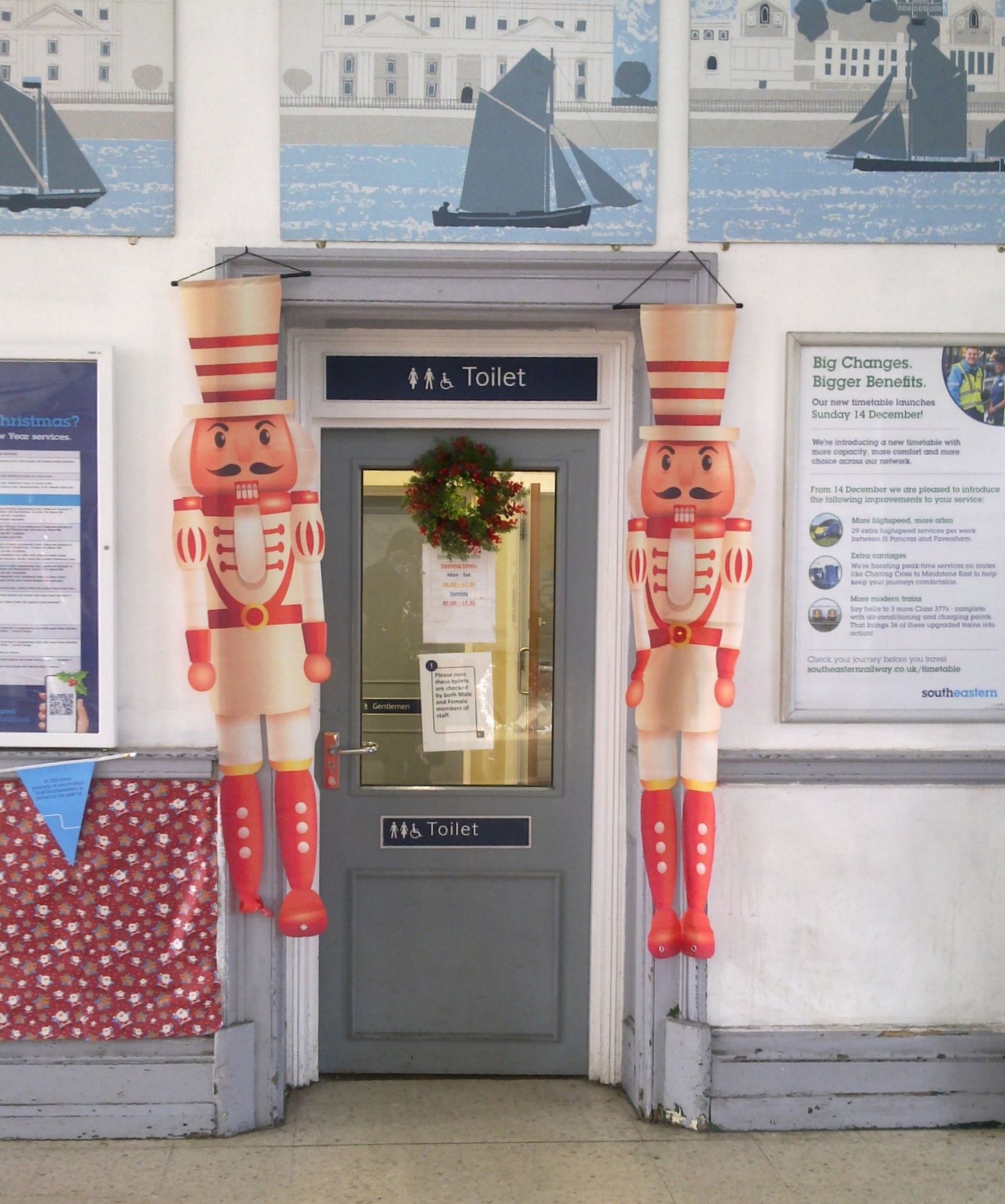
Railway stations at Deptford, Greenwich and Woolwich have some displays to commemorate Rail 200. At Greenwich station last year the Christmas decorations were particularly lavish; the photograph shows an example. In the room behind the door there were numerous large boxes wrapped in Christmas paper. Is this initiative in any way connected with Rail 200 or do they do this every year?
Chris Green read English at Oxford. In 1984 he was appointed manager of Scot Rail and he was in charge of South-East trains from 1986. An illustrious railway career followed. With an interest in the built heritage, later in life in 1995 Chris was for a time chief executive of English Heritage. He has a substantial Wikipedia article.
The London and Greenwich Railway was London's first steam-hauled passenger railway. It opened from Spa Road to Deptford in 1836. Bob Carr

 In GLIAS Newsletter December 2025 you asked why a German fan heater was called a Bopser. Simply, really, it's the Stuttgart suburb where it is, or used to be, made.
Robert Bosch established his first workshops in Stuttgart in 1886 and factories followed. The city became known worldwide for electrical innovation and excellence. Bopser became a brand name for small electrical appliances. Stewart J Wild
In the Stuttgart suburb of Bopser there is a large Porsche Museum and at one time the intention was to have a Mercedes Benz Museum there too. This is now located elsewhere.
The photograph in the previous GLIAS newsletter suggests that because of its style, this small electric heater might have been designed before the war and perhaps with Bauhaus influence.
GLIAS has or had members who are interested in 1930s artefacts and art deco. Do we still have any of these? Can someone give us an insight into the style and design of this product? Bob Carr
Taken on a misty morning in November 2025, this photograph shows a view looking south from near the Town Quay in Barking along the river Roding towards the Thames. Astonishingly on the left hand side there appears to be a factory with a smoking chimney. This is part of the Boathouse Studios, now an arts centre; the appearance of smoke is probably steam from the central heating system condensing in the cold air.
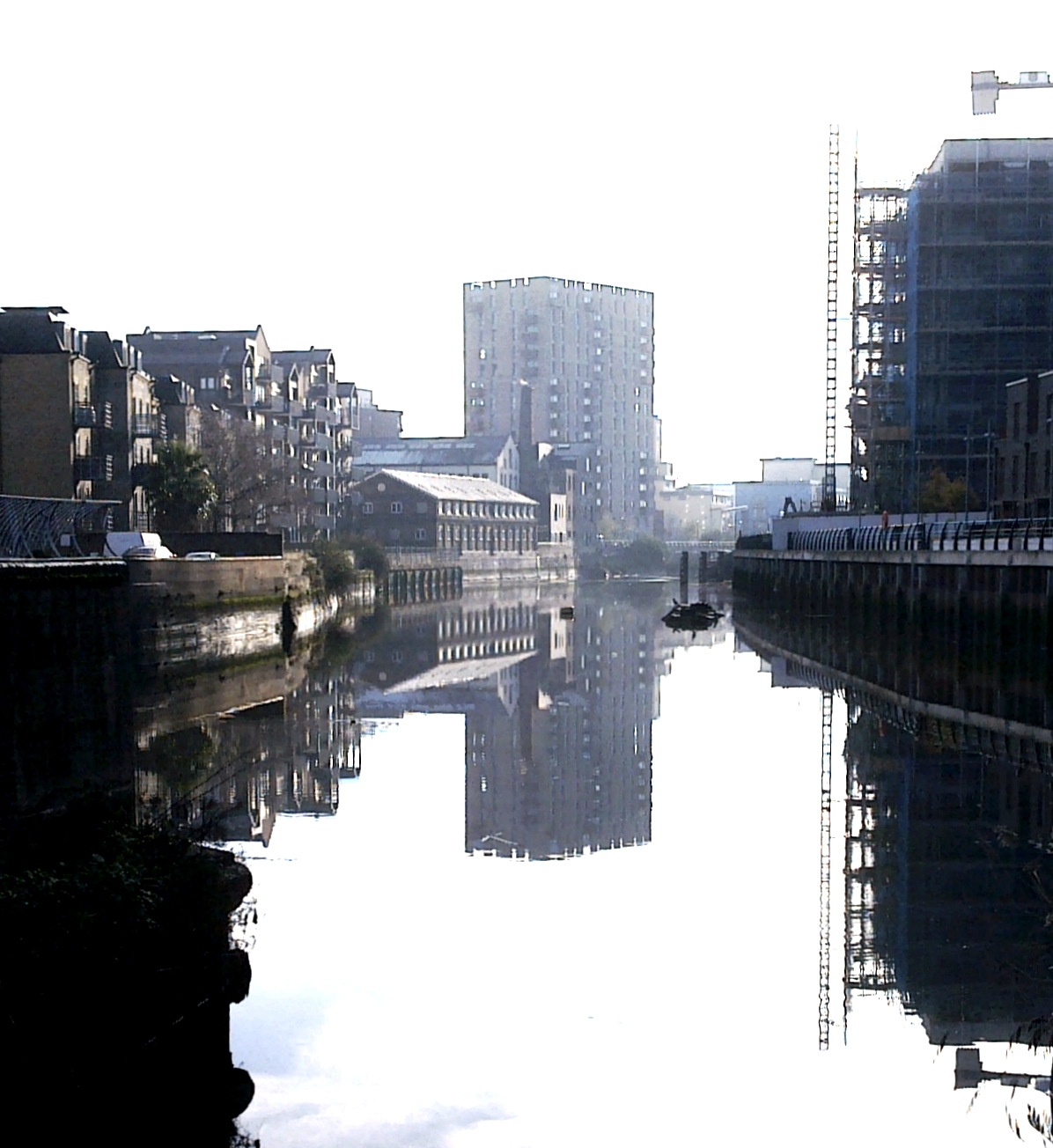
At the Town Quay itself there is a listed building, the Old Granary at TQ 439 837. This is mid-19th century of yellow brick four storeys high, with an attached tower five storeys high. Of Italianate character, it was listed grade II in 1968. It is or is being converted for flats.
Further south of here on the east bank of the River Roding are the Boathouse Studios with the 'smoking' chimney, mentioned above. These are an arts and event space at approximately TQ 442 834 which forms part of The Ice House Quarter located at 56 Abbey Road.
The Barking Barrage c.1995 extended the navigable length of the River Roding from High Bridge Road to just north of Hand Trough Creek. It has radial gates which can only be opened when the tidal water from the Thames is at a sufficient height. There is a fish ladder and an eel pipe.
This tidal barrage maintains the water level of the river north of here making it suitable for use as a yacht haven as far as the Town Quay. On the west bank of the river Roding just above this barrage are a number of craft which look like barges in size, some of which seem to have been converted for accommodation.
There is still much to discover in this area. Bob Carr
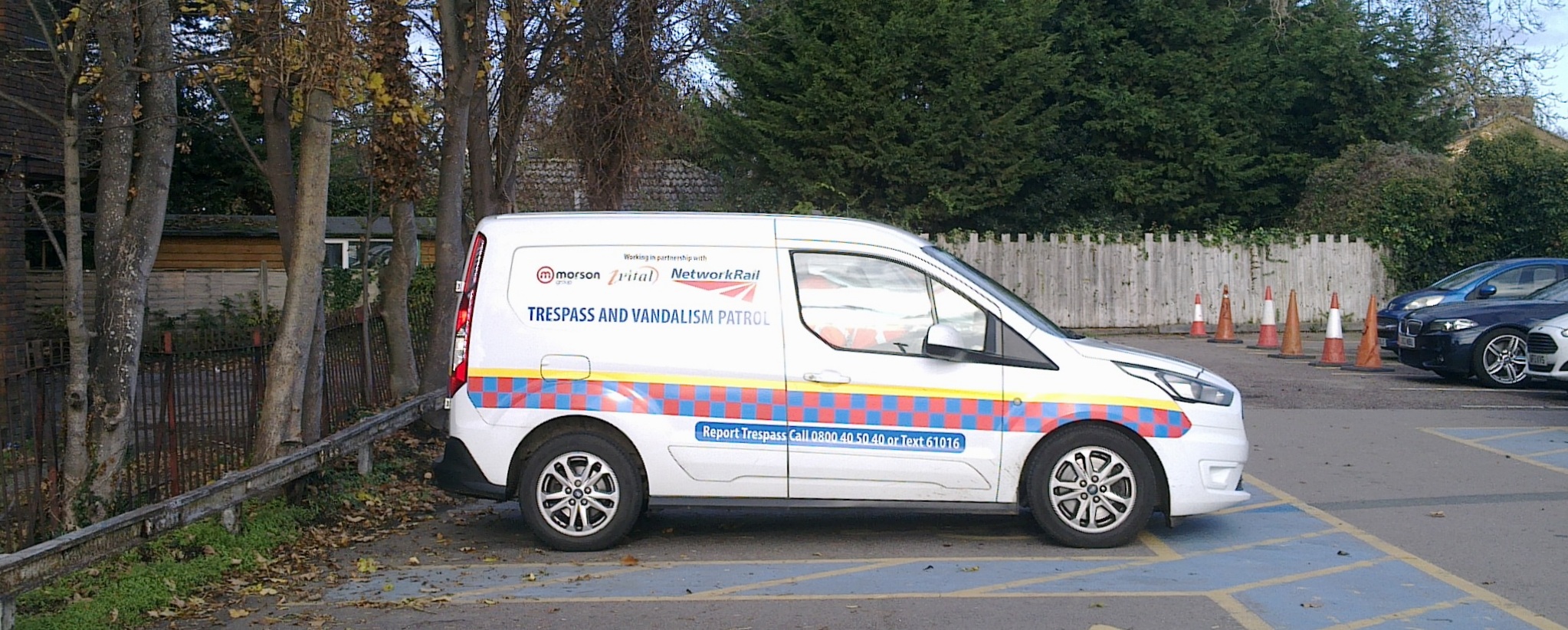
Problems regarding trespassers on railway main lines and the theft of signalling cables have been increasing. There is now surveillance with dedicated vans patrolling. The photograph shows one these Trespass and Vandalism Patrol vans at Biggleswade in November 2025. Suspicious-looking people with notebooks or cameras beware. Bob Carr
Kenley airfield is essentially a historic site with public access, although there is gliding activity. The runways here were completed in 1940. You should fairly easily get to the north end of a runway from Kenley Common which is just a short walk to the west from Whyteleafe railway station. Footpaths lead onto the Common from Hilltop Road and Stumps Lane. The Bulleid Battle of Britain class locomotive 34068, built at Brighton in October 1947, was named Kenley. Bob Carr
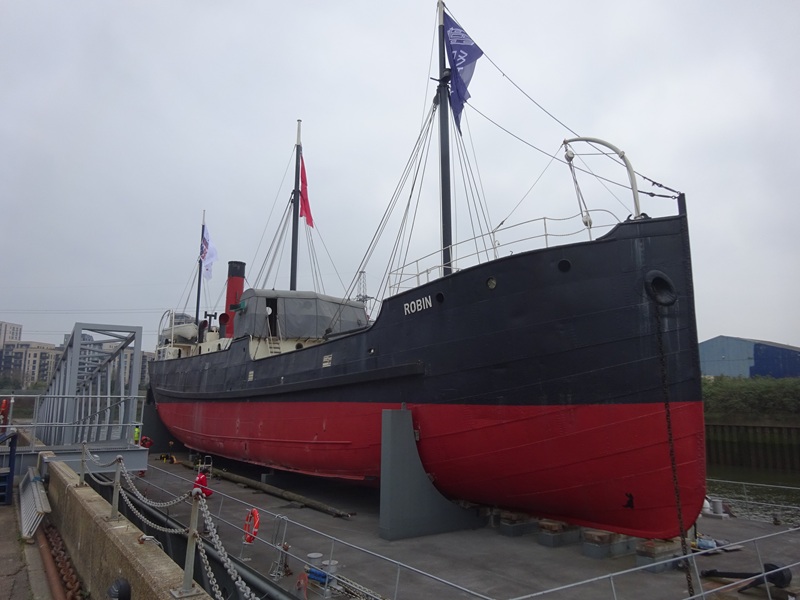
The SS Robin has been moved from Newham and is now at Trinity Buoy Wharf on her pontoon.
The Barking gasholder at TQ 433 844 is a fine sight and appears to be in very good condition. From a distance it looks complete, and much the same as when it was decommissioned.

A new small ship has been active on the Thames in 2025 and has been quite busy lately. This is Diesel Dog, a river tanker which supplies diesel oil and drinking water to vessels. She was built in 1971 at Delft in the Netherlands — 79 feet long and 53.7 tons gross. Diesel Dog is something rather similar to the small ships that J J Prior used to operate. Presently you can see her from time to time under the bridges in Central London. A very nice design, at the moment she looks really spick and span.
At Beckton the columns which supported the jetties where ships were unloaded are still in place. Will they ever be repurposed? At East Greenwich gasworks, repurposing of the jetty has to some extent occurred. Currently remnants are supporting the Quantum Cloud sculpture and assist in retaining the floating landing stage in place.
Royal Wharf Pier is very handy if you want access to the Royal Docks from south of the river and don't want the anticipated horror of crossing over on the cable car. Some of the cars have glass floors — but not all of them. Timid people that go this way might have quite an unpleasant experience. Going underneath you can see the cars bobbing about in the wind. Bob Carr
Eagle-eyed readers may have spotted signs like this in the Camden area. The link at the bottom will take you to a website (www.trackingtheheritage.com) which promotes, among other things, the Camden High Line (GLIAS Newsletter December 2020).

The website is very much interactive and seeks to engage users with the industrial heritage of the area.
Ladykillers' locations — 70 years on
Last year marked the 70th anniversary of the classic Ealing comedy The Ladykillers which was filmed extensively in the King's Cross area.
Much loved by industrial archaeologists, the film is a snapshot of how the much transformed area used to be.
The British Film Institute website (www.bfi.org.uk) has an interesting piece with then-and-now photographs of the area showing how much change has taken place.
The Newsletter has covered the redevelopment of the area several times down the years (see, for example GLIAS Newsletter June 2024). Also we highlighted how film and television has inadvertently provided a record of industry in the city (GLIAS Newsletter February 2020).