In this issue:
- From the chair
- Planning to archive: part 1
- Polygon Buildings, Polygon Road, London NW1
- The Tate Institute
- Maze Hill pottery
- News in brief
- Liverpool Street station
- The dog returns (and the pot!!)
- GLIAS walks
- Administrative notice
- 343news.pdf
April's Newsletter marks the start of our new Membership Year and you'll find the appropriate reminder with this Newsletter.
Meanwhile, we've started our 2026 Lecture series with London's Railways and Industrial Development by Dr Richard Mark which gave an interesting perspective on the economics behind the spread of rail transport in January and a look behind the scenes of one of London's IA sites with Nicholas Weedon speaking on Brixton Windmill in February. In March Alan Burkitt-Gray looked at Short-Cuts from the Thames to the Channel: Why South London's Canals Failed.
Our lectures continue until May which will include the AGM. Do invite anyone you know who might be interested as the lectures are open to all and free to attend.
Also, looking forward, there's SERIAC 2026 on Saturday 25 April and you'll find details and booking at https://tinyurl.com/SERIAC-2026
We will need some help with administration for SERIAC on the day from registering attendees to checking in those who have booked car parking. Do get in touch with chairman@glias.org.uk to offer help.
Our walks over the summer are being planned, keep an eye on the newsletter and website for details.
Thanks for your support for the Society over the past year and I look forward to your continuing support for 2026-27. Dan Hayton

As a society, GLIAS has increasingly less opportunity to visit and record industrial history because many of the traditional industries and companies have disappeared or ceased to function, health and safety makes visits more complex and companies are either un-resourced or wary of allowing visits and surveys. Consequently, while there is obviously still much research to be done, our formal recording activity is now very rare. But I suggest that this gives the Society and our members an opportunity to retrench and ensure that what records we have amongst us are not lost.
Many GLIAS members will have stacks of boxes of IA slides, albums of photos, megabytes of digital folders and maybe unpublished research or fieldwork. I know that a number of important collections are in risky limbo or have even been lost because their creators have suffered big life changes or have sadly passed on. They didn't prepare their information to be suitable for archiving nor make provision for what to do with it when they were able. It seems very sad that a lifetime's interest and work could be lost, so I am proposing to write a series of pieces on archiving for the Newsletter to promote discussion and to hopefully share the experiences of others — good and bad — with a view to encouraging members to think about their collections and to take action to preserve at least a part while they can. You may have only a few pictures that you don't want lost to posterity, or maybe much more.
First, the best way to ensure a continued life for your work is to publish it. Both the GLIAS Newsletter (newsletter@glias.org.uk) and the GLIAS Journal (journal@glias.org.uk) welcome contributions, and are widely read online — thanks to Google, we often receive queries about the content of both, going back years. Both Robert and Alan have space waiting for your copy. Our member Sid Ray was a good example; he took amazing photos of industrial London in the 50s and 60s, some of which he shared with us in a series of Newsletters until he sadly passed away last year. Fortunately, he has made provision for the rest of his collection so it will not be lost.
Another easy way to publish is to contribute to IA gazetteers such as www.industrialhistoryonline.co.uk or www.gracesguide.co.uk — it's easy to update or add new entries to both using your own photos and records. The former holds the official GLIAS database and our editor, Robert Mason, has written extensively to encourage its use. He is waiting keenly to help newcomers...
When talking about 'archiving', I'm actually thinking of a wide range of activity from leaving the best of your photos in such a way that they will be kept and shared by your family through to depositing material in a formal archive such as The London Archive or Camden Local Studies & Archives Centre. In all cases the material needs to be marshalled and presented in a particular way. The dross — underexposures, duplications, irrelevances, poor quality — need to be weeded out and the rest identified and presented in a way suitable for the final archive. The archives don't have the resources to do this themselves, so are likely to reject an unedited data dump.
I am proposing looking at the following in subsequent months:
- Photos: hardware and software to digitise slides and prints; software to improve photos; what format?; software to manage digital images.
- Documents: hard copies or scans?; how to present?
- Copyright: provisions for published items — ensuring copyright ownership is passed on
- How to Archive?: family; industrialhistoryonline; Grace's Guide; formal archives
- What do members have to archive?
- Can GLIAS help our members to archive? (A discussion rather than a promise!)
I am certainly no expert in any of this, so if there are accomplished photographers or archivists reading, I would welcome your support and suggestions. Similarly, I would like to hear the experiences — good or bad — of anyone who has undertaken any of the activities outlined above. I'm hopeful that future pieces will provoke discussion, but I would also welcome input before I write more. (>>>)
Tim Sidaway. Email: Tim_Sidaway@btinternet.com
Polygon Buildings, Polygon Road, London NW1
In the middle of Somers Town two astonishing buildings were built on the same plot of land 100 years apart. The buildings are long gone, as is the address, Clarendon Square. To add to the confusion both buildings were named The Polygon; but they could not have been more different.
The first Polygon in Clarendon Square was a flamboyant classic Georgian development of 32 houses. Somers Town was semi-rural at the time. In the 1800s people like William Godwin, Mary Wollstonecraft, Mary Shelley and Charles Dickens lived there. Over the century the houses fell into disrepair.
The population of London increased dramatically in the 1800s. For many living conditions were overcrowded and unhealthy. Things got even worse as thousands of homes were demolished to make way for the new railway lines and stations, Euston (1837), King's Cross (1852) and St Pancras (1868).
Clarendon Square was owned by Lady Isabelle Somers-Cocks, one of the wealthiest women in England. She saw the terrible housing conditions of working people and decided to do something about it. So when the lease expired she decided to build 'artisan dwellings' on the site.
It did not go down well.
30th Jan 1891 LCC Superintending Architects Department:
-
'... the scheme appears to be objectionable from more than one point of view. The increase appears to be objectionable as the neighbourhood is at present densely populated and to add to this density is sure to be attended with ill results. I recommend that this application is not granted.'
In July 1892, the out-gunned LCC gave permission for the dwellings. In a peevish tone Mr Blashill, LCC Superintendent Architect wrote
-
'I beg to inform you that consent of the council is hereby given subject to the condition that the buildings herein referred be commenced within six months and completed within eighteen months from the 21st June 1892... if the plans or application be hereafter found to be inaccurate in any particular way, the forgoing consent shall be null and void.'
The flats were for working people with good references. Lady Isabelle ensured the rents were affordable, at 2/-6 pw per room. They were very popular. By the 1950s most of the tenants were railway employees.
Polygon II was not pretty, but it was well planned, indeed developers today could learn something. For example, large outdoor and indoor drying spaces, laundry rooms, hygienic rubbish chutes directly to basement bins, large playing grounds for children, trees.
There were four blocks — A and B block and C and D block. The pairs faced each other. Between them was the 'dummy yard' with access to the basement bin area. Children were not allowed to play there. Each block had four floors, plus the fifth floor/roof. This housed the washing and drying facilities and two bathrooms. Water was heated in coppers. One bathroom was reserved for those with infectious diseases. The laundry room had about 12 sinks, drainers and coppers arranged around the walls. It must have been quite a sociable space for women. The drying areas were used until the flats were demolished. The washroom and bathrooms were no longer in use by the 1960s.
Each block was divided into three sections with their own entrance. For fire safety the sections were connected at roof level. Each floor had six flats, two one-room, two two-room and two three-room flats. There was one toilet per two flats and a communal scullery with three large stone sinks and brass cold-water taps. Each flat had built-in coal bunker and storage cupboards. Originally, they had small iron ranges for cooking, heating and hot water and gas light. Electricity came later.
Milk and coal had to be carried up to the flats. Imagine the arduous work of the coalman carrying hundredweight sacks of coal to each flat during the winter.
-
'I remember Tommy the coalman, a small wiry man, his face black with coal dust always wearing a 'paddy cap' and sparkling blue eyes. He would come around with his horse and cart and shout 'any coal' in the yard. Women would call out window what they wanted'.
'I had a paper round in 1950s. If the gas lamps were out on the landing, I'd have to grope around to find the letter boxes.'
-
'The cleanliness as well as the domestic and sanitary advantages of the dwellings account for their great popularity. Two rooms for five shilling and three for seven-and-six are rare indeed in the neighbourhood.'
In 1966 Camden Council bought the Polygon from British Rail. Residents were gradually rehoused, starting with A and B block. The council used the vacated flats as temporary housing for homeless families. The Polygon soon became quite notorious. The small flats, shared toilets and lack of hot water would be difficult for the new residents.
-
'The Polygon has been synonymous with everything that is worst in homelessness, why should homeless families be punished?' The Camden Journal November 1971
In the 1970s Camden Council built a stylish development on the site. Many of the flats were sold off under Right to Buy scheme and the streets are now eerily quiet. The well-heeled have returned to Clarendon Square? Hilda Varley
The Tate Institute in Silvertown, established by Henry Tate, was built in 1887. It served as the Tate sports and social club and probably played a role similar to that of SAFA House for Stones in Deptford (GLIAS Newsletter October 2025). The Tate Institute closed in 1937 and the building was used as a local library until 1961.
The Institute was boarded up in 2011 but in 2016 a group of artists took over the building. Rubbish was being cleared in 2016 and temporary repairs carried out using salvaged material in 2025.
A major refit is now taking place. ReSpace Projects have transformed the building which due to reopen as a community centre when the work is completed in 2027. Funding has been provided by the Greater London Assembly and Newham Council. It is perhaps a mere pipe dream but could this eventually become 'Tate East'?
The Institute was handy for Tate's workers, being just across Albert Road. The address is 1 Wythes Road E16, TQ 422 801, (only a very short walk away from 'The Girl from Sandwich' café). Bob Carr
From time to time Maze Hill Pottery holds open days. A pre-Christmas open day was held in 2025 over the weekend of 6-7 December and I am very grateful to Lisa Hammond for kindly allowing me to visit her pottery and take photographs on the following Monday.
The interior of the former booking office was temporarily rearranged as a reception and display area for the open weekend. The room would generally be crowded with piles of clay and potters' wheels.
At Maze Hill there are two kilns, a large and a small one. The photograph (below left) shows the large kiln in the foreground, with the small kiln further over to the right. The large kiln is about 30 years old and was made by Lisa Hammond herself. It takes about 10 days to fire and unload this kiln, so this is generally done more than a week or so before it is needed to be emptied. The small kiln further over to the east is a recent rebuild and has now been rebuilt twice. It takes six days to pack, fire and cool this kiln before emptying. Both kilns are gas-fired from the mains.


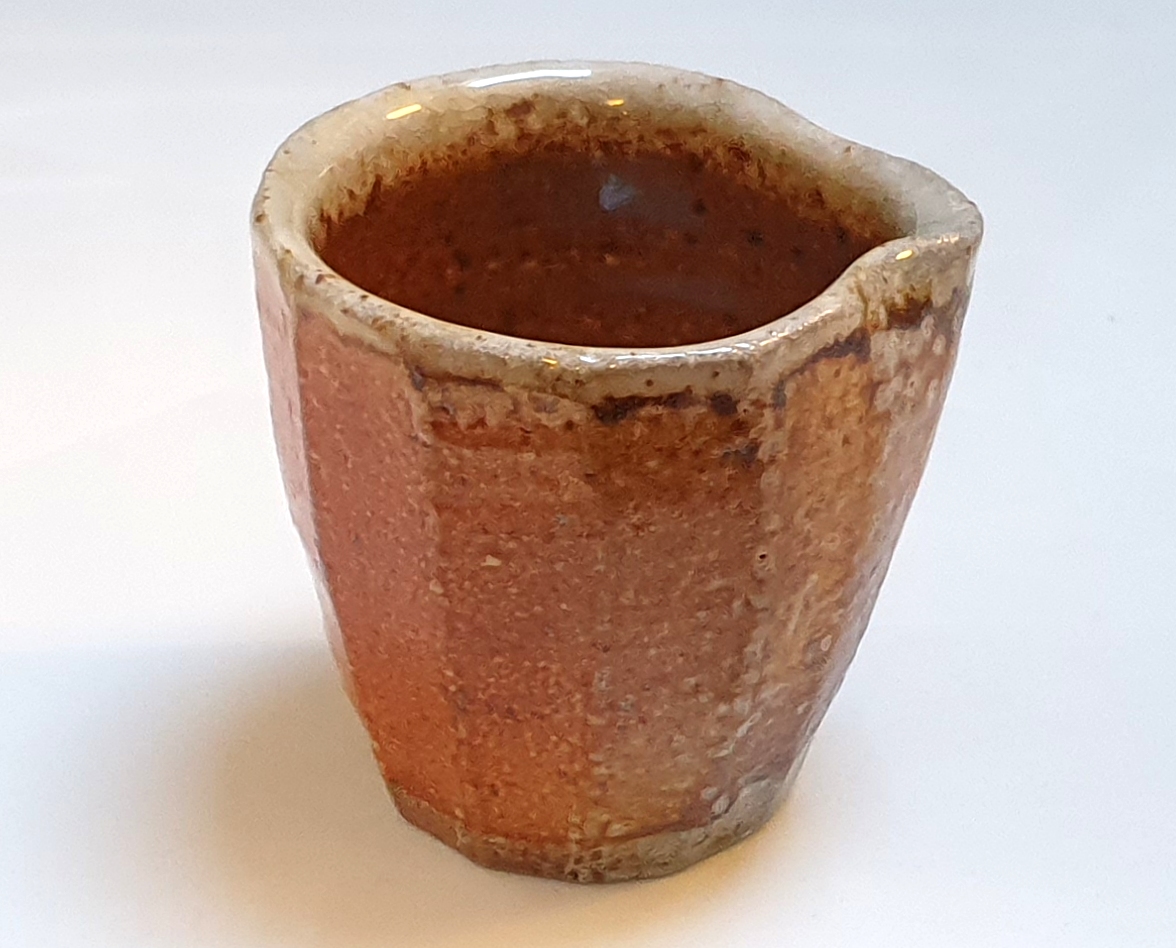
The photograph (above centre) shows pottery fresh from the kilns in the process of being cleaned for sale. Waddings are used on the bottom of the pots to separate them from the kiln shelves and these have been removed.
Wadding is an important part of soda firing. It prevents the pieces from sticking to each other or to the shelves of the kiln. Wadding needs to be very refractory to prevent it from melting.
At Maze Hill pottery a small proportion of china clay is mixed with a high proportion of granular alumina. The latter has sufficient resistance to the soda so that the waddings come free of the pot after firing. The china clay is added to make the wadding mouldable like clay.
The soda firing process starts with the preparation of the kiln. Pottery is loaded into the kiln, usually with wadding to prevent the pots from sticking to the shelves. The kiln is then heated to high temperatures, typically about 1,290°C.
As the kiln reaches its peak temperature, historically soda ash was introduced. This can now be done by dissolving sodium bicarbonate in water and spraying it into the kiln. A vapour results which reacts with the silica in the clay bodies and glazes, forming a sodium silicate glaze. This interaction results in a variety of surface textures and colours, including glossy, matte, and even orange-peel effects.
Salt-glazed pottery was formerly produced on South Thameside but this is no longer permitted owing to environmental concerns. The Maze Hill Pottery produces soda glaze ware.
Soda glaze, which has a similar appearance to salt glaze but without the acid exhausts, was tested and developed for their use by Lisa and students at Goldsmiths' College in the 1980s where Lisa was a lecturer. Lisa has been soda glazing ever since.
Lisa Hammond is an internationally renowned potter; she was awarded an MBE in 2016. At Stoke-on-Trent she founded Clay College to teach pottery. Lisa travels worldwide to lecture. Bob Carr. With many thanks to Lisa Hammond MBE
-
Ref. See GLIAS Newsletter 339 August 2025 pp5 & 6.
 Despite the most enormous number of protests the City of London has agreed to the scheme to redevelop Liverpool Street railway station. A massive office block will be built at the east end of the station dwarfing the Great Eastern Hotel. Parts of the listed railway station will be demolished. The Victorian train shed itself should survive but the 1985-1991 extension to the south is to be removed.
At Edmonton the rubbish destructor which generates electricity is now well past its best before date. The replacement currently being constructed is behind schedule and there are increasing costs so it may now not be completed until 2027, and perhaps even later. Environmentalists object to burning rubbish to generate electricity but it is defended on the grounds that doing this is a better option than land fill.
The original Edmonton plant will remain until at least 2030. Bob Carr
The Quentin Blake Centre for Illustration is due to open in the New River Head site in Islington in May. Their scheme converts New River Head's five historic buildings into accessible exhibition galleries, a learning studio, a project space, a café-event space and a shop, surrounded by gardens. Web: https://qbcentre.org.uk/
Hammersmith & Fulham Council has approved plans to restore and repurpose the Grade II* listed gasholder at the King's Road Park development. Gasholder No 2, built between 1829 and 1830, will be dismantled, refurbished and re-erected in a public space in the brownfield regeneration project led by St William, a Berkeley Group company.

I wonder what John Betjeman would have made of the current proposals for the redevelopment at Liverpool Street Station.
I expect many members will recall that back in 1977, when there was a proposal to demolish and rebuild the station, John Betjeman led a campaign to retain it. As part of that campaign a 'Round London Stations Walk' was organised. The walk started at Liverpool Street and went anticlockwise round ending at Fenchurch Street.
I took part in this 'walk' and ended up with T-shirt, so I can say Did that, got the T-shirt!
I wonder if any other members took part? John McGuinness
The dog returns (and the pot!!)
Charles Dickens' father was imprisoned in the Marshalsea Debtors' Prison in 1824. So even an 11-year-old Charles had to go to work in a shoe polish factory. Warren's Blacking Factory stood where Charing Cross railway station is now. Many shops at the time advertised their wares by hanging trade signs over their street facades. A few of these survive around London, eg the tobacco roll hanging in New Cross.
Dickens later wrote: 'My usual way home was over Blackfriars Bridge, and down that turning in the Blackfriars Road which has Rowland Hill's chapel on one side, and the likeness of a golden dog licking a golden pot over a shop door on the other.'
The sign was in fact attached to the wall of Hayward Brothers ironmongers shop at Number 23, St George's Place, Southwark. It is believed to date to the early 18th century and to have first been attached to an inn. The sign next appeared over Number 25, Walker's ironmongery shop. (Ironmongers made and sold both '[fire] dogs' and cooking pots). When Walker retired it was moved it to Number 23, which remained an ironmonger's works until being destroyed in the Second World War. Following years of weathering the decaying sign was transferred to storage in the Cuming Museum.

The dog-in-the-pot coal-hole covers were commonplace in London streets but only a few survive in situ (GLIAS Newsletter August 2002). Hayward also made covers without the image of the dog. Some years ago GLIAS member the late Peter Skilton rescued one and gave it to Kirkaldy Testing Museum.
Hayward Brothers also patented the prism glasses that form the basement lights for hundreds of buildings in London and around the country (see picture, below left, taken at Abbey Lane Pumping Station, Leicester). Their name is usually cast into the frame of the lights. On the company's centenary in 1953 a book on the history of company was published. It can be read in full on the following website https://glassian.org/Prism/Hayward/YOR/fdj.html


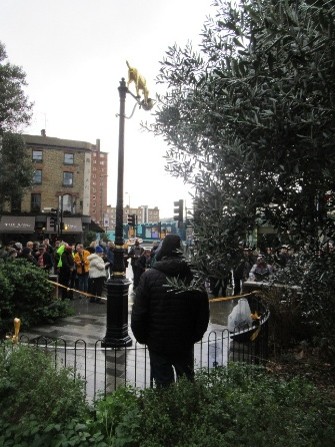
On 7 February 2026 (Charles Dickens' birthday) the restored sculpture (pictured above) was unveiled in the pouring rain by Ollie Dickens, his great-great-grandson. A tea party including birthday cake was then given by the residents of the nearby flats to the wet group including myself and Olwen who had attended the unveiling. The repaired and regilded statue of the dog by the local art college can be seen diagonally across Blackfriars Road from Southwark Tube station. David Perrett
P.S. I would be interested to hear of surviving Dog in the Pot coalhole covers and other Hayward street furniture d.perrett647@btinternet.com
The GLIAS walk on 6 June will explore the Whitechapel area, largely following the route originally published in a GLIAS leaflet in 1994. There is an opportunity for members to help with updating information on the area prior to the walk or to lead the walk on the day. If interested in either, you are welcome to make contact via walks@glias.org.uk.
Andrew Turner, walks coordinator
Please note that as a result of new guidance from Companies House, we have transferred our Registered Address to:
-
Suite A, 82 James Carter Road, Mildenhall, Bury St Edmunds, Suffolk, England, IP28 7DE
Tim Sidaway, GLIAS Secretary