In this issue:
- From the chair
- Help wanted/situations vacant
- Adriaan Linters (1951-2025)
- Anne Ramon (1957-2025)
- Nicholas Grimshaw (1939-2025)
- Paddington
- Historic England schedules telecoms cable winding gear in Greenwich
- Myths associated with industrial archaeology
- What's in a name?
- Richmond station
- News in brief
- Bopser?
- Brewery Wharf
- Occupational injury!
- Books
- 341news.pdf
We confirmed the programme for SERIAC 2026 at our Committee Meeting, to be held on 25 April 2026 at Stanley Arts, South Norwood.
Going forward we've been wondering where Industrial Archaeology is headed, particularly in London, when development of 'brownfield' sites are hedged around by access problems, contamination, commercial sensitivities and security to name but a few.
GLIAS has been active in exploring and recording industrial features over many years but, in the current climate, getting onto sites to survey and photograph in detail is more and more difficult, if not impossible. One way to pursue fieldwork is to make use of the Database where sites in your locality can be recorded and updated as the details change from research, redevelopment or, sadly, decay.
Do get in touch with database@glias.org.uk for further details.
... and finally, Season's Greetings to all. Dan Hayton
The Society has been run by volunteers throughout its existence and in changing times we would like 'new blood' with interest and skills in 'Social Media' and the management of the Society's activities. Do get in touch with chairman@glias,org,uk to volunteer or for a chat over coffee.
Adriaan Linters died of cancer on 31 May this year. He had intended to visit England in 2023 and be at the AIA conference in Bath but his health precluded this.

He had studied industrial archaeology with Angus Buchanan in Bath. Then, an impecunious student, he used to hitchhike to Southampton to hear Edwin Course lecture in the evening.
He built up a large collection of books at his house in Kortrijk with the intention that this library would be open to all and sundry who had an interest in industrial archaeology.
Adriaan's impressive Wikipedia entry makes clear that he was highly regarded in Belgium. In recognition of his life's work he received the European Heritage Award in 2019 and in 2024 was awarded the Sarton Medal from Ghent University's Faculty of Engineering for his half-century of dedication to industrial heritage.
I once met Adriaan Linters at St Pancras railway station and we went to see the interior of the then newly refurbished St Pancras hotel which only catered for the seriously rich. I took him to have a cup of coffee and I explained that I could afford to buy him coffee but not much else. The price of a coffee there was similar to the price of a modest meal elsewhere! He was very impressed by the Gothic decor, presumably by George Gilbert Scott. Later he referred to 'Holy St Pancras'.
I well remember his kindness when I went to Lille with him to explore the area where TICCIH 2015 would be held. We later caught the train to Kortrijk. He was very generous and friendly and this really was a very memorable day with much about flax scutching. I think that was probably the last time I saw him in person but we corresponded fairly often since.
There was one night a week when he would go out and buy chips from the local Kortrijk chip stall. Very much a Belgium speciality as those of us who have been to Belgium will know.
Adriaan Linters (1951-2025) was one of the founders of industrial archaeology in Belgium and had been involved in the development and preservation of industrial archaeology since 1971. He was a leading figure in industrial archaeology. He was also a good friend. The death of Adriaan is a personal one. Bob Carr
It is with great sadness we report the death of GLIAS member Anne Ramon. In recent years she was an active member of the London Topographical Society and with a background in banking she served as their treasurer for a time. Anne was also very active in family history. She died unexpectedly in October. A great shock to many. Bob Carr
The architect Sir Nicholas Grimshaw has died at the age of 85. Among his achievements in London he designed The Financial Times printing works, East India Dock Road, 1988; North Woolwich pumping station, Newham 1988; and Sainsbury's supermarket, Camden Town, 1988.
Then there was Waterloo International railway station, 1993; Lord's Cricket Ground Grandstand, London 1998; Paddington station redevelopment, 1999; and The Cutty Sark conservation project, Greenwich 2012.
The Financial Times printing works was a masterpiece. Passing by in the evening you had a wonderful kinetic display, hundreds of yards of pink paper racing through the two great presses comparable in size to the steam engines at Kempton Park. National newspapers are no longer produced in this way. See GLIAS Newsletter 177 August 1998, p6. Bob Carr
At Paddington basin electric boats can be hired by the hour. After a brief period of instruction you then can sail off and explore the canals on your own. These electric do-it-yourself boats are provided by GoBoat and are fitted with a table. You can see parties of people with a picnic on board. Similar facilities are available at Canary Wharf and Kingston, on the River Thames. Life jackets can be provided.
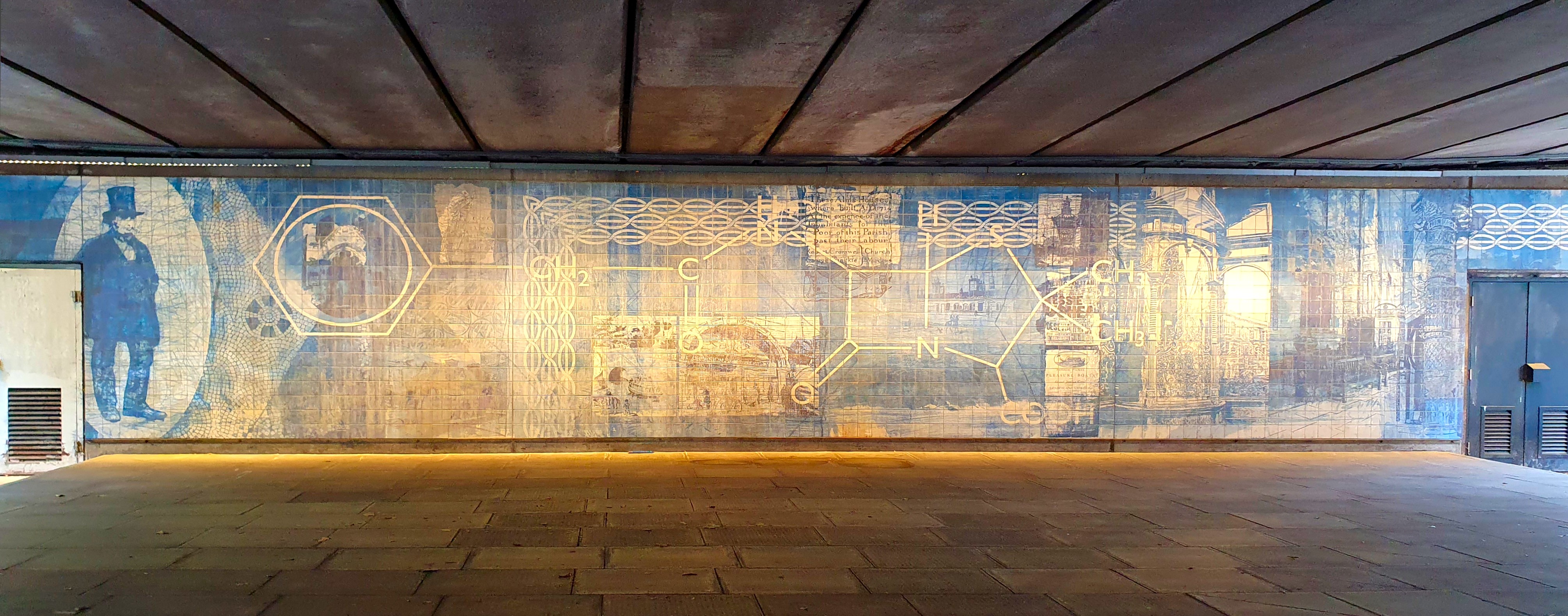
The photograph shows the mural in the pedestrian underpass beneath the A40 Marylebone Flyover. This is part of a pedestrian route from Paddington Green to Paddington Basin. The mural marks I K Brunel, the GWR and the local area including the canal as well as celebrating St Mary's Hospital and the introduction of penicillin.
At Paddington railway station the most recent architectural work there has been by Nicholas Grimshaw, 1999. Bob Carr
Historic England schedules telecoms cable winding gear in Greenwich
The equipment in Enderby's Wharf, Greenwich that loaded TAT-1, the first transatlantic telephone cable, on to the ship that laid it from Scotland to Newfoundland is now a scheduled monument. Included in Historic England's listing is a gantry that was used to transport some of the earliest subsea telegraph cables from the factory alongside to cable ships in the Thames.
I submitted the listing proposal to Historic England in January 2023 and I was informed of the decision — which required the signature of Lisa Nandy, the culture secretary — in the first week of October. The monument was scheduled from 9 October 2025.
I'd never been through such a process before, but was hugely helped by people such as Oliver Pearcey, who worked for English Heritage and also chaired the Kew Bridge Engines Trust. There were others, including some who work for the subsea cable industry.

-
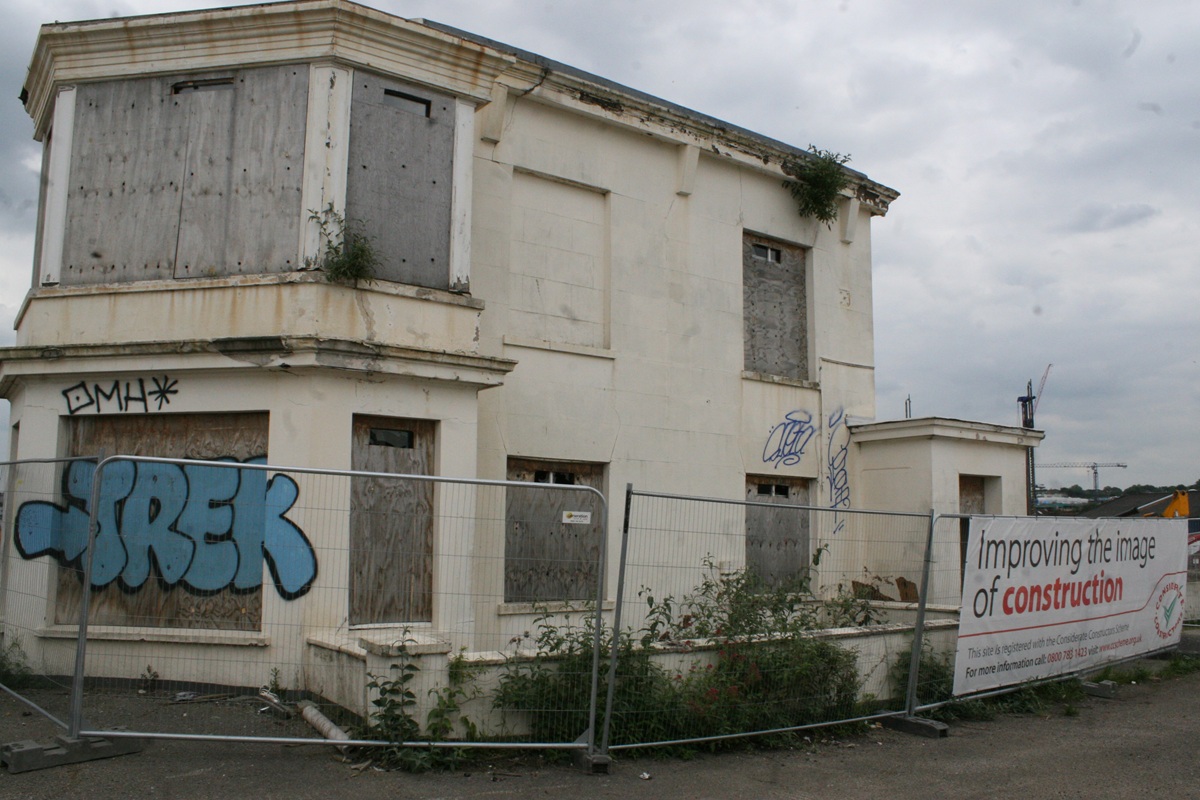
(left) The winding gear at Enderby's Wharf in October 2025, now scheduled, seen from the listed Enderby House pub; (right) Enderby House abandoned to vandals in May 2014. Pictures © Alan Burkitt-Gray
The equipment and the jetty on which it stands belong to Alcatel Submarine Networks (ASN), a French company that is one of three or four in the world that build the subsea cables that connect us all together. ASN long ago moved cable manufacture to its main base, Calais, but still makes equipment in Greenwich, in a factory that stands on part of the same site where the first experimental transatlantic cables were made in the 1850s. There is a continuous 170-year history of telecoms manufacture on the site.
One of the delightful surprises of the scheduling decision is that ASN appears very happy. A few days after HE's announcement, I was contacted by Taj Bhambra, the managing director of the UK operation. He is working with HE, the local authority — the Royal Borough of Greenwich — and the nearby pub, Enderby House, about a way of permanently celebrating the site.
Grade II listed Enderby House is an intriguing case. In the early 2010s ASN had sold off the land closest to the river to Barratt, the building company. In 2014 I and a number of other locals, such as Mary Mills of the Greenwich Industrial History Society, realised that Enderby House, which had been the head office of the original telegraph company, was at risk. It was protected against vandals and arsonists by nothing more than a flimsy fence — see picture. Mary, with Dan Hayton, Elizabeth Pearcey, and I, plus others, formed the Enderby Group to campaign to save it. We published pictures and met the builders. Very quickly the developers erected a secure fence and planned to expand the building as a pub.
Enderby House, a listed building, and the now scheduled winding gear are two of a trio of historic sites associated with international telecommunications. Just across the river, on the Isle of Dogs, is the scheduled site of the Millwall Iron Works, where Isambard Kingdom Brunel built the Great Eastern, launched 1858. It failed as a passenger liner but from 1864 financier Cyrus Field hired it as a cable ship for the first successful transatlantic cables and the first connection to Mumbai. Alan Burkitt-Gray
Myths associated with industrial archaeology
There are persistent folk tales that any amount of historical research cannot dispel. For instance, there has been the story of a South London child, often a little girl, exploring rough ground who fell down a hole and found herself in a Victorian underground railway carriage. The remains of the passengers were still there, as skeletons in top hats, long dresses, and so on.
This tale seems to be compounded from the 1950s TV science fiction series Quatermass and the Pit and a BBC Radio Goon Show, broadcast not long afterwards, which was a send-up of the Quatermass programmes. The Goon Show mentioned an underground train with passengers delayed so long that they survived only as skeletons. There is also an association with the pneumatic tube railway of 1864 which was demonstrated, carrying passengers, in the grounds of the Crystal Palace. Here a demonstration carriage was blown through a 600-yard tunnel which was in fact not underground. There have been serious archaeological attempts to find remains of the Crystal Palace trial railway and excavations have firmly concluded that no remains exist.
If the child in the story is a girl we might also mention Lewis Carroll's Alice as a source. Alice after all did have some memorable adventures underground. The book Alice in Wonderland was published in 1865 just three years after the start of underground railways in about 1862.
Folk stories such as the above are regularly repeated and survive as an oral tradition passed on by word of mouth. Leading walks one is often told such tales by people like security guards or foremen, and they appear to believe such stories absolutely. Their faith is apparently unshakeable. Any attempt to dispel such beliefs is futile and results in one being regarded as a deluded fool. 'I KNOW this to be true — I talked to a man, who talked to a man, ... , who was there *. The authorities tried to hush this up at the time, you know'.
The media repeat the hoary old tale of the rivetter and his boy entombed within the double hull of I K Brunel's SS Great Eastern and only discovered when the ship was finally broken up on Merseyside. This is a story that just would not lie down. L T C Rolt spent considerable effort trying the verify this tale and concluded that it was false. See Isambard Kingdom Brunel by L T C Rolt, chapter 15.
Then there is the often-repeated tale of all the people who committed suicide by jumping off the high-level walkway which runs between the two towers of Tower Bridge.
A more recent myth is that the ghost of George Livesey haunts the Millennium Dome. This story was publicised by the media.
Richard Dawkins tells us that a good story persists longer than the truth. The better the story the longer it survives.
Have readers come across similar examples? No doubt AI will generate some fresh myths; 'I know this is true — my computer says so'. Bob Carr
-
* cf the Between the Wars popular song 'I danced with a girl, who danced with a man, who danced with a girl, who danced with a man, ... , who danced with a girl who danced with the Prince of Wales'
The Arsenal Tavern at the junction of the Blackstock Road and Mountgrove Road, N4 2JS, has had its name changed to The Brook Gate.

The Arsenal Tavern had been a popular venue for football supporters but had little custom when Arsenal were not playing at home. The idea of the name change was to make this pub more attractive to a wider audience, previously put off at the thought of rowdy fans. The venue now has a different image and it hopes to attract more women.
In the past the New River flowed close to the site of this public house, near the point where the Hackney Brook and New River met. There was a sluice here where people fished and it is claimed that trout were caught. Seeing the present day surroundings this sounds like a really tall story!
The New River was originally built in the early 1600s to bring clean drinking water from Hertfordshire to London. This 'new river', an aqueduct, was built to follow the 100-foot contour which meant that when it came to the valleys of small streams there were some large detours to the west. When the New River reached the Hackney Brook it followed the 100 ft contour well out to the west, almost as far as the present-day Holloway Road. Over the years most of these extravagant meanders were removed by building a shortcut to the east.
The first of these shortcuts to be built was the one across the Hackney Brook which was built very early, in 1619 *. Known as the 'boarded river' it consisted of a wooden trough lined with lead to keep it waterproof. This trough ran over the Hackney Brook along what is now a section of the Blackstock Road.
On the Hackney Brook there was a sluice just to the west of the boarded crossing. This was probably to control the flow of the brook beneath the crossing, that is under the wooden aqueduct. Depending on the flow conditions the sluice used to create a pool on the west side of what is now the Blackstock Road.
The Hackney Brook flowing from west to east is now one of London's lost rivers. In flood the Brook could be 30 feet wide by the time it got to Stoke Newington and 100 feet wide at its mouth on the river Lea.
The Hackney Brook appears to have been a trout stream and children could catch trout in the pool formed by the sluice, probably by tickling them, and it has been said even take them home to their mother to cook for lunch!
From the clientele one now sees in The Brook Gate the renaming policy and change of atmosphere seems to be having some success. For many years the Blackstock Road was known as Boarded River Lane. The wooden trough conveying the New River ran along a part of it which was less than 100 feet above sea level for something like 150 years or more.
Taken in October 2025 the photograph shows The Brook Gate public house looking northeast. The pool where fish could be caught would have been just to the left. Bob Carr
-
* Exploring the New River by Michael Essex Lopresti, ISBN 9780947731496, p11
The two-year renovation of Richmond station was officially completed in September.
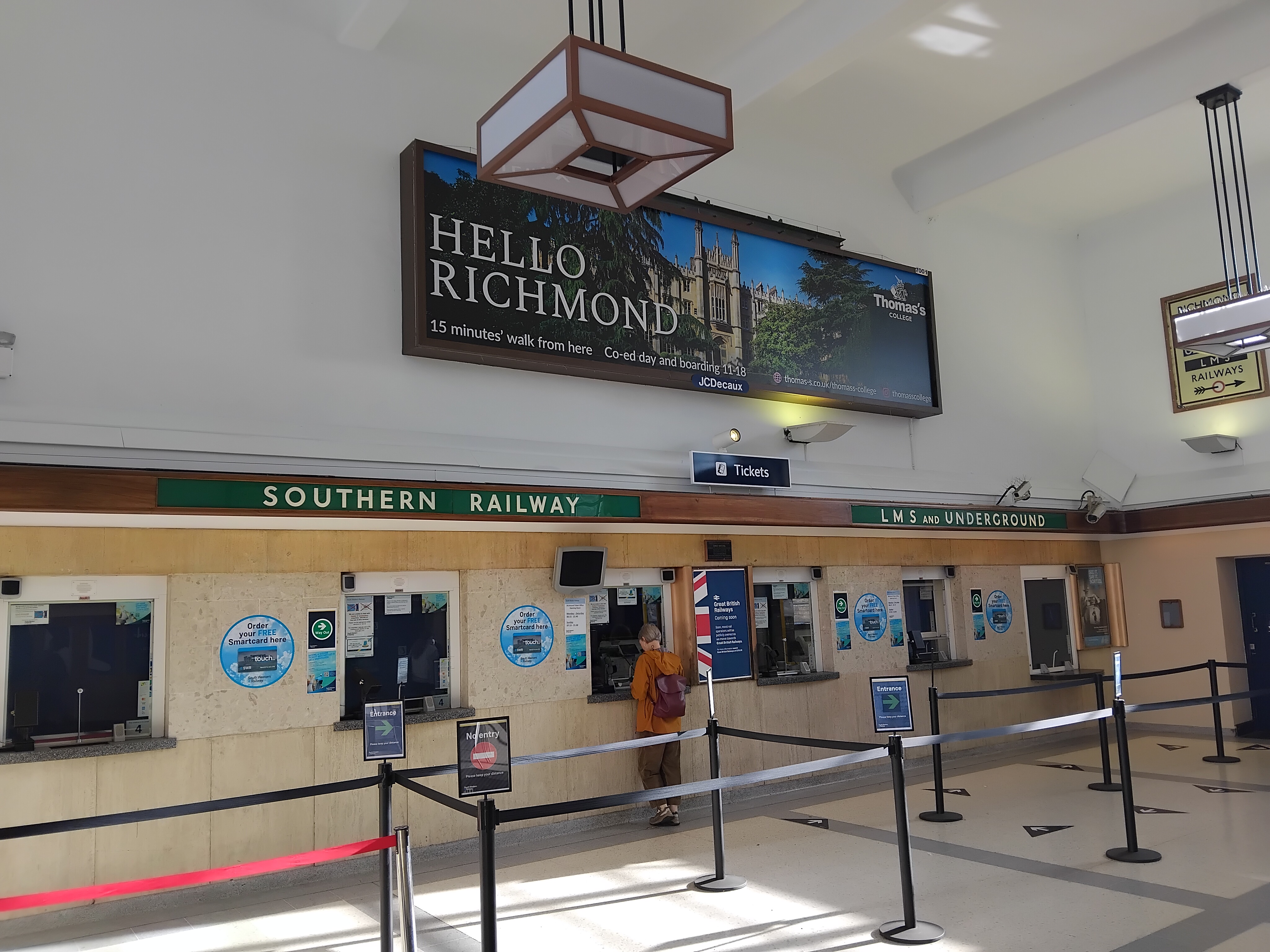
The project to restore the 1937 station to its Art Deco glory began with a deep cleansing of the Portland stone exterior, followed by the repair and polish of the tarnished bronze and mahogany entrance doors, and the reinstallation of the high-level station sign with the bronze lettering at the top of the façade.
Additional repairs were made including new flagpoles redeployed to their original position, flying the National Rail Double Arrow, and the use of period-appropriate paint colours to keep in with the building's original appearance.
The ticket hall was given a 1930s facelift, including a period-style chandelier and retro posters and signage.
The ₤325,000 project was carried out by South Western Railway alongside partners including Network Rail and the Railway Heritage Trust.
First opening in 1937, Richmond station was built by the Southern Railway team, led by chief architect James Robb Scott.
 The final tunnel on the High Speed 2 rail route from London to Birmingham has now been completed. On 13 October 2025 the tunnel boring machine (TBM) broke through at Washwood Heath near Birmingham. This ends 18 months of work to create the Bromford tunnel and means the end of major excavations for the 28 miles of tunnels between Old Oak Common and Birmingham Curson Street station.
Next year it is intended to start work constructing the tunnel from Old Oak Common to Euston Station. A pair of TBMs will cut twin bores.
With the additional length of cuttings, trains using HS2 will only be in daylight for part of the journey. But since most passengers will be looking at mobile phones and laptops do we now need many windows in trains? With just a few roof lights and the odd porthole carriages could be constructed lighter in weight and more cheaply.
Newspaper journalists have written much on the fact that HS2 is being exceptionally expensive due to the nimby effect. Railway historians will not be surprised; Robert Stephenson's original London and Birmingham Railway was exceptionally costly because of objections by the major landowners along the route. They insisted on diversions and excessive compensation, which they received. The London and Birmingham Railway was one of the most expensive British railways to be built.
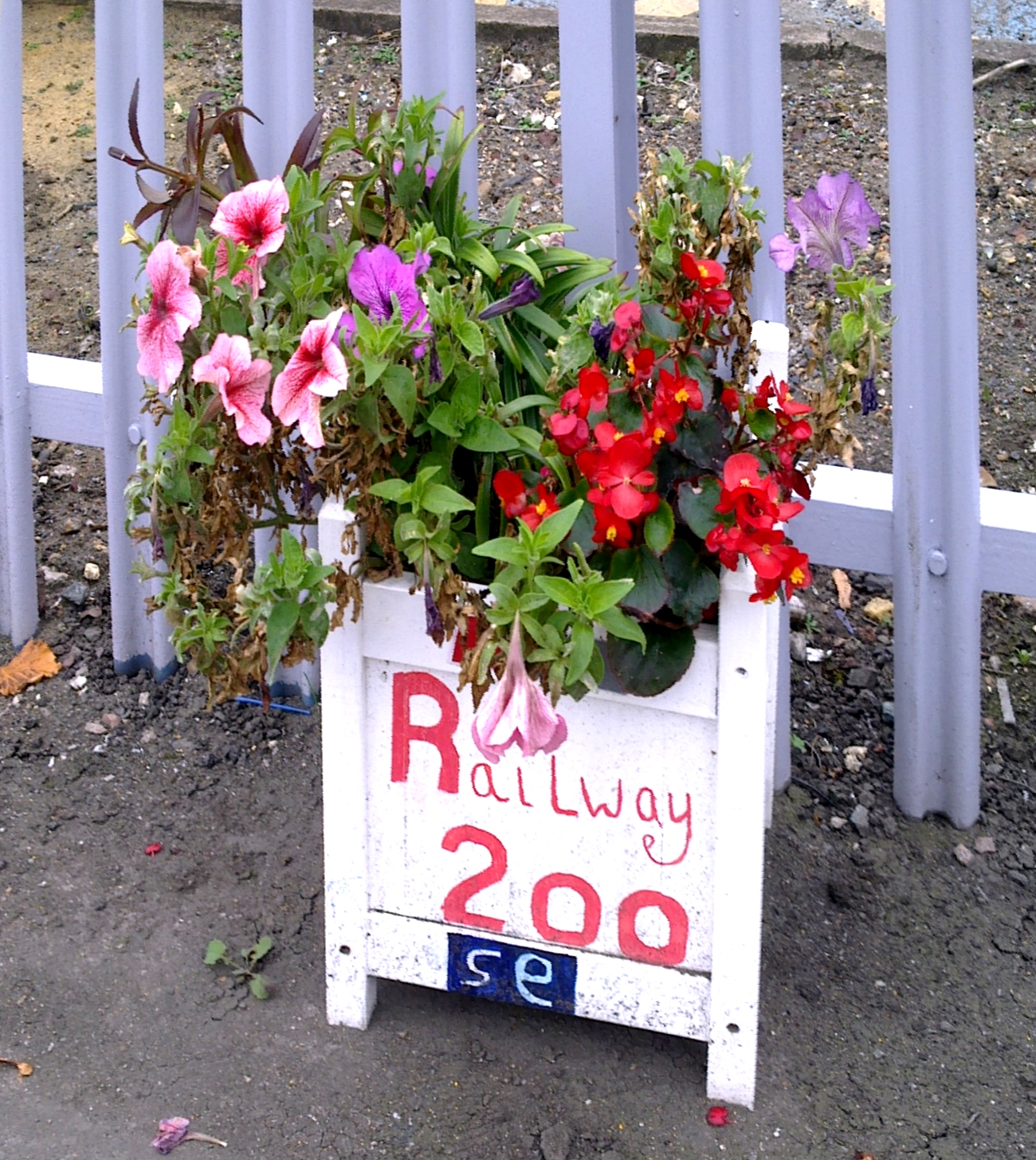
Rail 200 marks 200 years since the opening of the Stockton and Darlington Railway in 1825 and is being celebrated by displays at many railway stations throughout Greater London. The two photographs show the commemorative display on the up platform at Woolwich Arsenal station in October 2025 this year. Bob Carr

The Lenox Project, which intended to build and launch a full-size replica of the Lenox, a naval ship that was built in 1678 in Deptford, has been wound up and the charity closed.
Bopser is a mountain in Germany.

This small electric fan heater is called a Bopser. Can anyone explain why? Bob Carr
Brewery Wharf is on the east bank of Deptford Creek, immediately south of the A200 Creek Road lift bridge. This was where James Prior's small ships brought building materials such as sand and gravel from Fingringhoe and places in Essex. Sadly this maritime trade has come to an end.

The photograph taken in May 2008 from the Creek Road Bridge shows the small motorships Mark Prior and Francesca Prior. Road traffic could be stopped and the A200 bridge opened to allow small vessels like this to pass further up the creek.
Mark Prior on the left was 104 feet long and built in 1969. Francesca Prior was built in 1965. These two motor vessels were originally built by or for the London & Rochester Trading Company. Are either of these ships still trading? A reader with access to the current edition of Lloyd's Register of Shipping should be able to tell us.
J J Prior's acquired Brewery Wharf in 1955 and had a concrete batching plant there. Bob Carr
The following report caught Dave Thomas's eye. It is a South East & Chatham Railway 'Minor accident' from 1912.
-
REPORT
Location: 14/12/1912, 06.20. Billingsgate Market.
Accident to: John Dawson, Vanguard, 4 Long Lane, Bermondsey. Age 16. Pay 10/- per week. Off duty one day.
Cut nose.
'Whilst this lad was taking the nosebag off horse 1319 the animal made a grab at the lad's face, catching his nose with its teeth, cutting same. Dawson was absent one day in consequence.
The horse is apparently very bad tempered as it wears a muzzle and I am therefore suggesting to Mr. Stanly that as the animal appears to be so vicious it would be better to get rid of it.'
Signed: Francis H Dent, London Bridge. London District Goods Supt.