 'The Industrial Heritage of the Chilterns', by Hugh Howes
2025, Chiltern Society. ₤30. www.chilternsociety.org.uk

In the course of my work on the Industrial History Online database I have consulted many gazetteers published over the past 50-60 years. None has impressed me more so than this 232-page publication by the Chiltern Society. At first sight it is visually stunning with modern typefaces, clear and well-designed graphics and plenty of well-taken and interesting photographs. About a third of the book (Chapter 7: The surviving heritage) is in the form of a Gazetteer, with the preceding chapters setting the context for these relics. This is where I think the book really succeeds in introducing industrial archaeology to people interested in other fields. For example, Chapter 2 (Chiltern towns) will appeal to local people interested in the places where they live while Chapter 6 (Chilterns at war) engages military historians. Chapter 5 (Social Chilterns) tackles issues relevant to modern society such as mental health and the legacy of previous generations' attempts to improve society. There are sections that will satisfy geographers, transport enthusiasts and those interested in manufacturing. The text is broken into manageable chunks with subheadings and bullet points, which makes it accessible to a younger generation interested in bite-sized information. But, at the same time, it is packed with detailed information for those who want to learn more. There is an extensive index and good bibliography too. The maps are excellent and the cross-references throughout the book make it a very useful guide for those wishing to explore the area. The Chilterns are only a short journey from London. City-based GLIAS members would do well to invest in this book and enjoy a few daytrips to an interesting part of the country. Robert Mason
'Shipbuilding in Greenwich', by Dr Mary Mills
88 pages paperback. London: Greenwich Industrial History Society, 2025. ₤10, available only as print-on-demand from Amazon.co.uk. ISBN 9798267255219
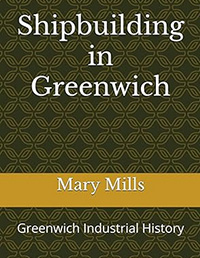
This is the latest in a series of books from Mary Mills of the Greenwich Industrial History Society. It follows a biography earlier this year of George Livesey, south-east London's gasworks boss, and earlier books on the Greenwich Riverside, the Greenwich Peninsula (for which she used to be local councillor) as well as Deptford Creek and Greenwich Marsh. This latest takes a topic that is not usually associated with the Royal Borough of Greenwich, which has, as she notes, the longest stretch of riverside of any London borough. Indeed, as Andrew Turner's GLIAS walk in October showed, there are lots of remains of ship-breaking on the Charlton foreshore, so it's not entirely surprising. The author adds parts of Deptford: until the 1970s, the borough included Deptford Dockyard, where Elizabeth I knighted Francis Drake in 1581. To the east, there was Woolwich Dockyard, and there were many private shipyards in between. Alan Burkitt-Gray
'The Woolwich Rotunda', by Emily Cole and Sarah Newsome, with Verena McCaig
vi + 196 pages paperback. Liverpool: Liverpool University Press on behalf of Historic England, 2025. ₤14.99. ISBN 9781836244592

As the Duke of Wellington, no less, notes in his foreword, the Rotunda was originally built in 1814 to celebrate the military victories of his great-great-great grandfather, the first duke. The Rotunda was designed by John Nash as part of his development on the site of Carlton House, and was first used for a fete to celebrate Wellington's victories, a year before the battle of Waterloo. It was moved to Woolwich as part of the Royal Military Repository in Woolwich to become a museum in 1820. It continued as such for 180 years; but then a sad story begins. The Royal Artillery set up a museum, Firepower, in the former Royal Arsenal site down the hill in Woolwich, but closed it in 2016, with the exhibits transferred to Wiltshire. The Rotunda, still in Woolwich, is in a declining condition, increasingly peripheral to the operations of the British Army'. Repairs in the 1970s were disastrous, and now there is scaffolding supporting the roof, which the writers hope is temporary while a permanent solution is found'. Alan Burkitt-Gray
'Abinger and the Royal Greenwich Observatory — The Recording of Magnetism and Time', by Peter Tarpley
SIHG has just re-published Peter Tarpley's book. There are 40+ copies available at ₤5 each; if you'd like one, please email publications@sihg.org.uk
More details at: www.surreyarchaeology.org.uk/content/abinger-and-the-royal-greenwich-observatory