In this issue:
- From the chair
- New River leaks and restoration
- The London Gasholders Survey, 2000
- Surviving London gas holders
- Urea and vitalism
- More on Aberfeldy Street
- Upminster Tithe Barn
- July 1996 bus ticket
- City of London (Markets) Bill
- Fire on MV Royal Iris
- Dockland Apprentice
- Rapide flights over London
- Docklands History Group's new identity
- Sutton milestones
- Corby Steelworks
- A mystery object
- Database spotlight 9
- Books
- 338news.pdf
It has been a busy time behind the scenes. As well as our lecture on Milestones in April it has been membership renewal time.
We've had an encouraging response from members paying by Bank Transfer, cheque or handing me 'used notes' at events. You'll receive a reminder with this Newsletter if we haven't recorded your renewal and if there's a problem do get in touch.
Between writing this and distribution we will have held our AGM and reports will appear later.
Looking forward, we will have our programme of walks over the summer and even further ahead we will be hosting SERIAC 2026 next April.
Anyone with ideas of a possible venue, south of the river (so we don't intrude on ERIAC's region) or who would like to help out with the organisation do get in touch.
Best wishes for a pleasant summer. Dan Hayton
New River leaks and restoration
The New River is leaking. The embankment to the south of Eade Road N4 is receiving attention; water was being lost at the rate of roughly 200,000 gallons per day. Previous drainage works diverted leaking water into the sewer network to prevent flooding but have not addressed the root cause of the leakage. Sheet piling is now being imbedded to improve the situation.
At the nearby East Reservoir work is taking place along the eastern and southern sides to insert sheet piles. At this nature reserve the path around the south and east sides of the reservoir is closed for a year. Silent pile driving is being used so as not to disturb residents. A low noise and vibration pile-pressing machine will press, rather than hammer, the piles to the required depths. There are Thames Water websites that give further information about the New River leakages.
A former stretch of the New River in Clissold Park was put back in water with new bridges about 20 years ago which has produced an attractive feature. This stretch of water is considerably wider than the original New River. Two new ornamental footbridges were built, each end being marked with the seal of the New River Company and 'et plui super unam civitatem' (and I rained upon one city). Bob Carr
The London Gasholders Survey, 2000
Danny Hayton's talk to GLIAS on 19 March reminded us of how much the London Gasholders scene has changed over the last 25 years, with nearly all now demolished, yet with several protected examples waiting for new high-rise apartments to be built inside them (see GLIAS Newsletter 329, December 2023, pp4-5). Apart from an early case in Dublin, c.2006, the pioneering instance for doing that was at the St Pancras gasholder station, from where four spectacular guide frames have been relocated to the adjoining King's Cross Central development. One contributor to this phenomenon is the high technical and aesthetic standards of design achieved by London's gas companies during the later Victorian period, another is London's ongoing prosperity, creating a shortage of land for housebuilding but generating the financial capacity to invest in the expensive works needed to refurbish and future-proof historic gasholder metalwork. Other parts of England and Wales have fared less well.
Traditional low-pressure gasholders met the diurnal fluctuations in consumer demand for gas by varying the volume being stored, but they were costly to maintain. The creation from the 1960s of the National Gas Transmission System, working at high pressure, enabled the principle of line-packing, whereby the mass of gas stored in the grid is adjusted by varying the pressure. But initially the network could not deliver gas fast enough to meet the surges in demand at peak hours, so gasholders were still needed locally. In 1998, there were nearly 100 traditional gasholders still at work in Greater London. British Gas plc then announced it would be eliminating all of its operational gasholders nationally within a finite number of years. That was achieved circa 2014, after continued improvements in the gas grid, but the site decontamination and demolition processes have taken much longer, while listed holders are excepted.
In 1998 I was freelancing as an Engineering Historian, and I was approached by the then English Heritage (the part of E.H. that later became Historic England), to help them understand London's particular legacy of historic gasholders. I had become very interested in gasholders from Brian Sturt's article 'Low-pressure gas storage', published in London's Industrial Archaeology No.2 in 1980. It was agreed I would investigate a study sample of 14 late-19th-century gasholders on seven sites in inner London. The sample avoided sites such as St Pancras that E.H. was familiar with already, but was selected with an eye to good quality and special characteristics, which would make them suitable candidates for consideration for listing or other protection. I visited the various sites by courtesy of BG's subsidiary Transco, who then operated the national transmission system.
I recorded on site the features of the selected holders and researched their histories from gas company minutes, maps and other records. At that time the Institution of Gas Engineers had an excellent library in London, where I was able to trace the evolution of the many structural and operational features of gasholders, using professional papers and textbooks published during the formative period in the second half of the 19th century. At that time, London's gas companies were frequently building the largest gasholders of their day, with ever improving expertise in building tanks, guide frames and holder bells. In 1879 George Livesey devised the revolutionary and materials-saving design concept, of regarding a guide frame as a lattice shell performing as a cylindrical cantilever. From my researches I devised an illustrated typology of the structurally distinctive different types of guide frames and I wrote 21,000 words on the General Characteristics of Gasholders. I also made confidential recommendations for listing.
My report was completed in 2000, but there seemed to be a change of heart by E.H. Until then, they had been pursuing their industrial monuments protection programme, of designating the most important features of an industry as listed buildings or ancient monuments, but it was then realised that looking after such remains, of ever increasing size, would be an intolerable burden. My report was shelved and it was not until 2016 and 2017 that additions were made to the lists, for Kennington No.1 and Old Kent Road No.13. Meanwhile, in the absence of any publication, I reformatted the principal section of my report and placed it as a pdf at www.academia.edu. Search for it by Googling 'London Gasholders Survey, Part A, General (with minor revs May 2014)'. For the seven reports on individual gasholder sites that I studied (Bethnal Green, Poplar, Hornsey, Kensal Green, Battersea, Kennington and Old Kent Road, touching on some other related sites), you'll have to contact me personally. Malcolm Tucker
-
Old Kent Road No. 13, built 1879-81. With its revolutionary structural design and ornament-free lines, this was George Livesey's foremost contribution to the design of gasholders and the last to have been listed. (Malcolm Tucker, 2024)
Dan Hayton's GLIAS lecture on gas holders in March and Bob Carr's evocative photo in the April Newsletter (GLIAS Newsletter April 2025) have prompted this summary of those surviving in Spring 2025. Malcolm Tucker's article (above) outlines his work in undertaking a survey in which much fuller historic and technical data are recorded. He has helped with the brief information, in turn including some provided by Brian Sturt.
The circle of Fulham No. 1 holder's upright supports, plus frames at King's Cross and the eight at West Ham are unchanged from previous mentions. This note covers all other holder frames.
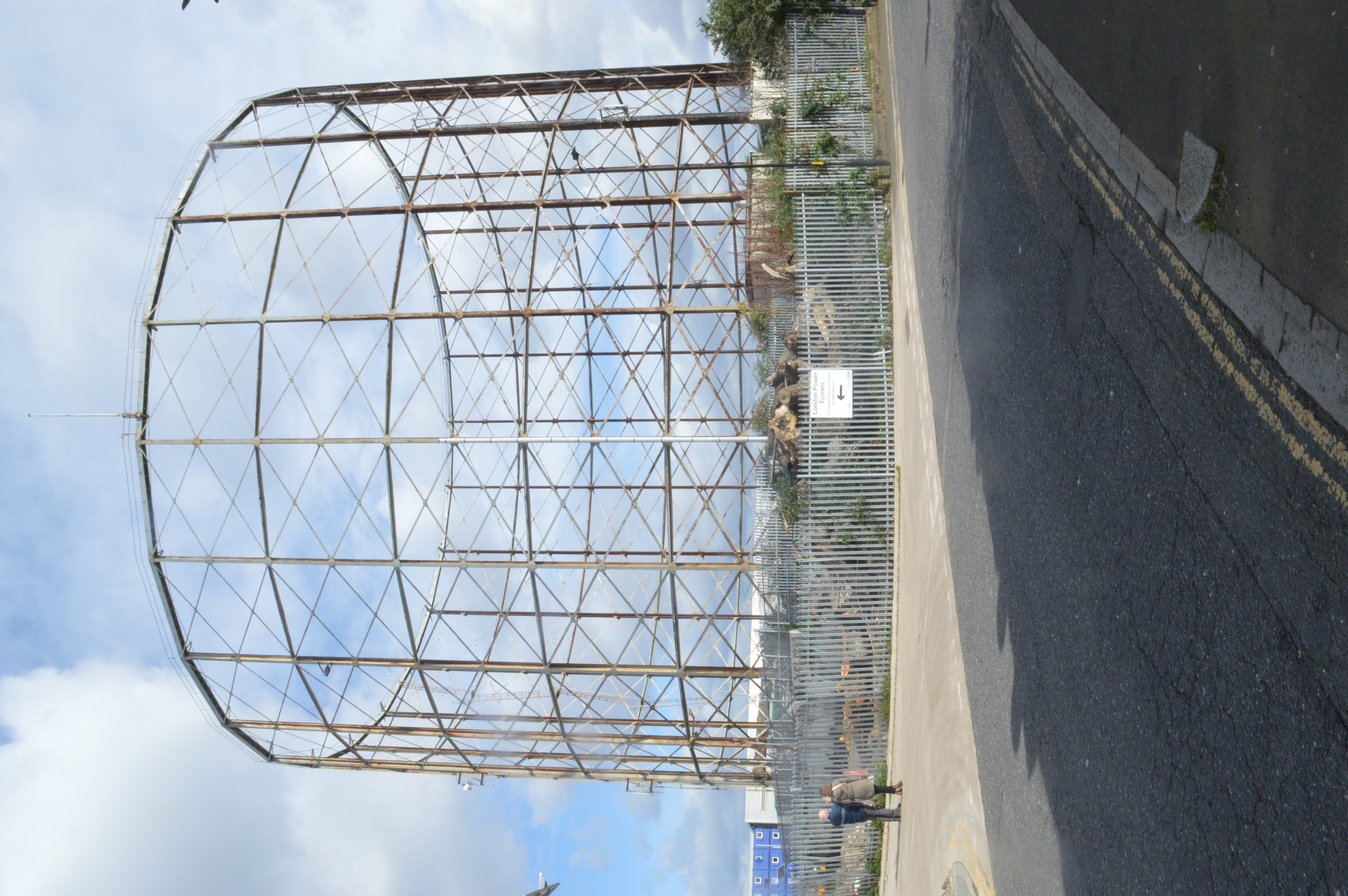
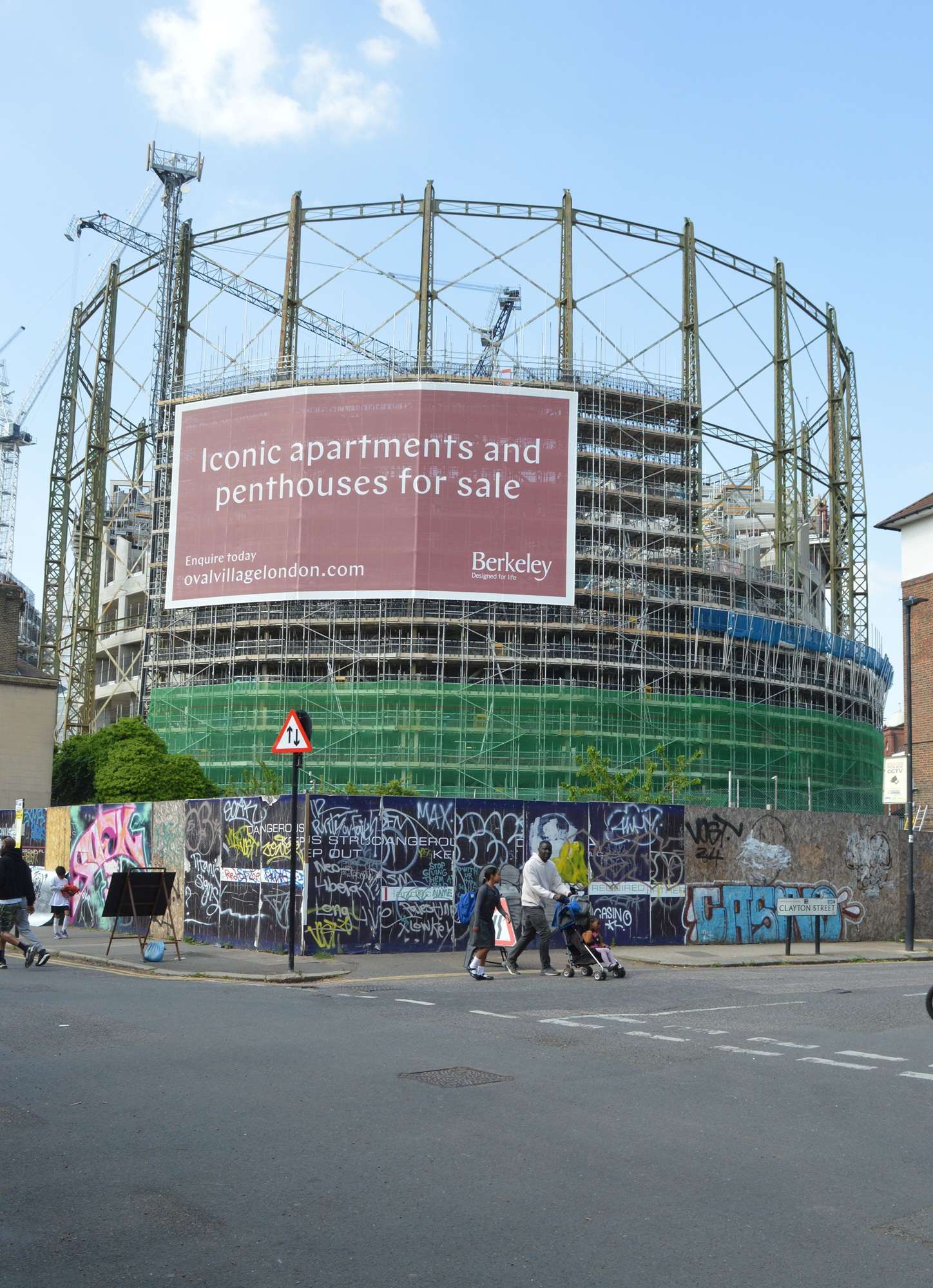
1. Kennington Oval. LB Lambeth. In 2020 four holders remained on this holder station site — it was never used for gas production. Holder No. 1, 1879, listed, has been retained and by April 2025 was being filled with concrete flats. As the large poster facing Kennington Oval side says, provided by Berkeley Homes. GLIAS Newsletter 300 (February 2019) has a 1975 photograph of the holders.
-
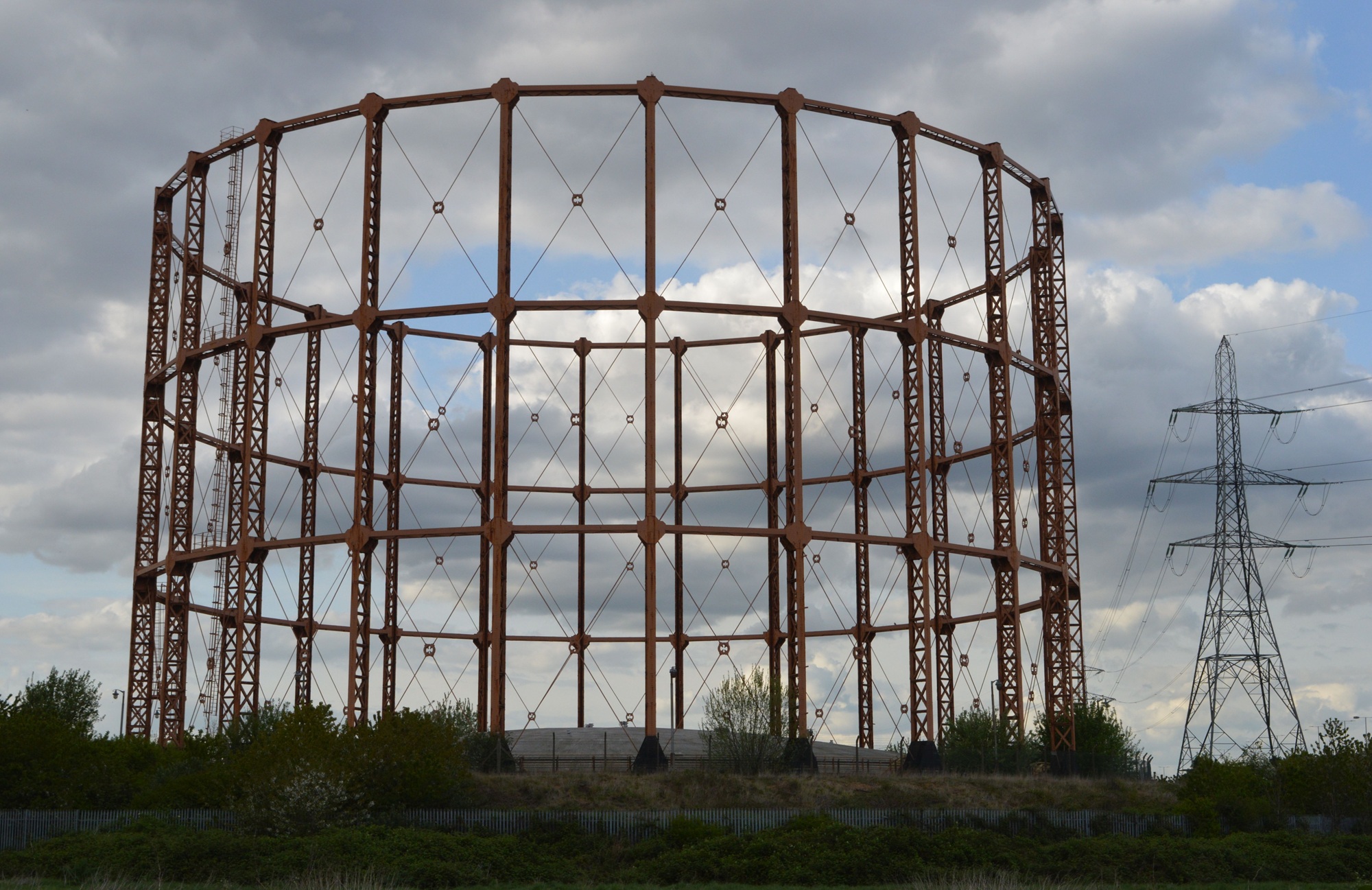
(Kennington Oval, 28 April, 2025); (East Ham, 22 April, 2025)
2. East Ham. LB Newham. Although within a large otherwise open area, this was only ever a single holder station, erected in 1903 for the Barking gas company. The surrounding space was largely playing fields and tennis courts, although the two vehicle-size entrances, on Watson Avenue and Leigh Road, plus London Midland and Scottish Railway once owning a strip of land to its east 1, suggest onetime intent for greater use of the site alongside the barge-navigable River Roding.

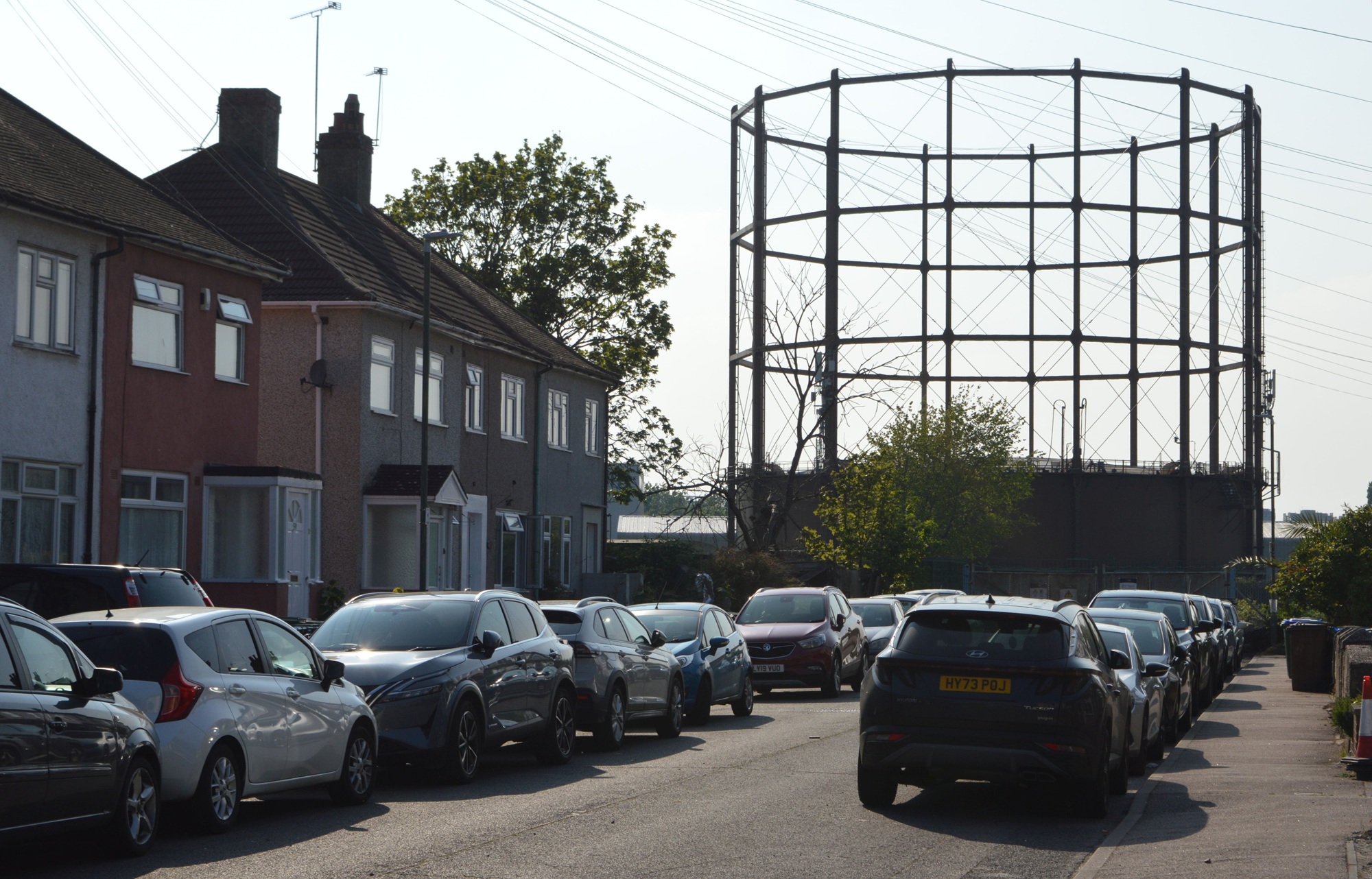
3. Belvedere, LB Bexley. Holder No. 1, 1923. Riveted steel guide frame standing on an above-ground rivetted steel tank. A second similar holder has already been demolished and housing is planned for this site, a largely empty space at the west end of Sutherland Rd.
-
(Belvedere, 28 April, 2025)
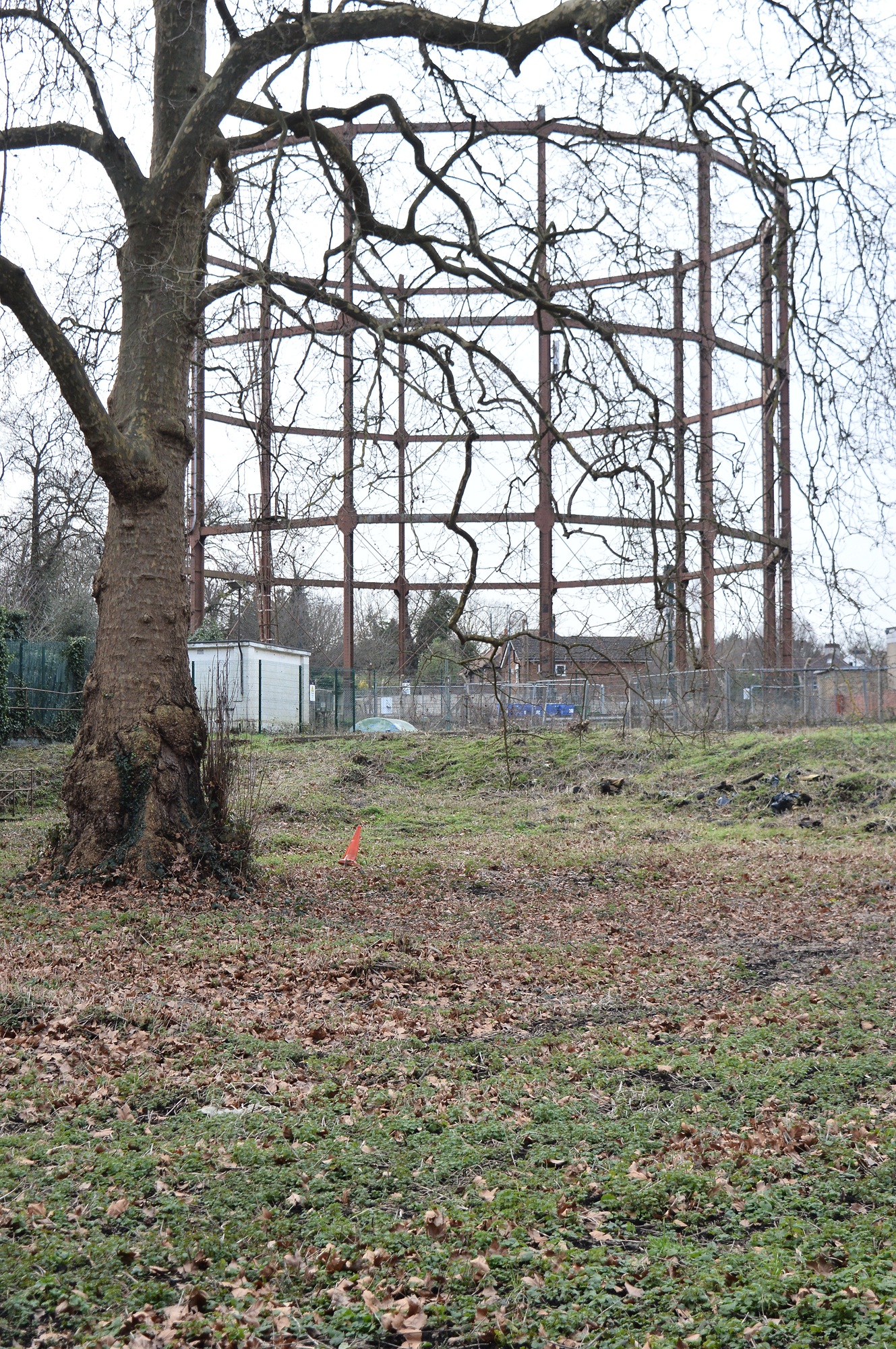
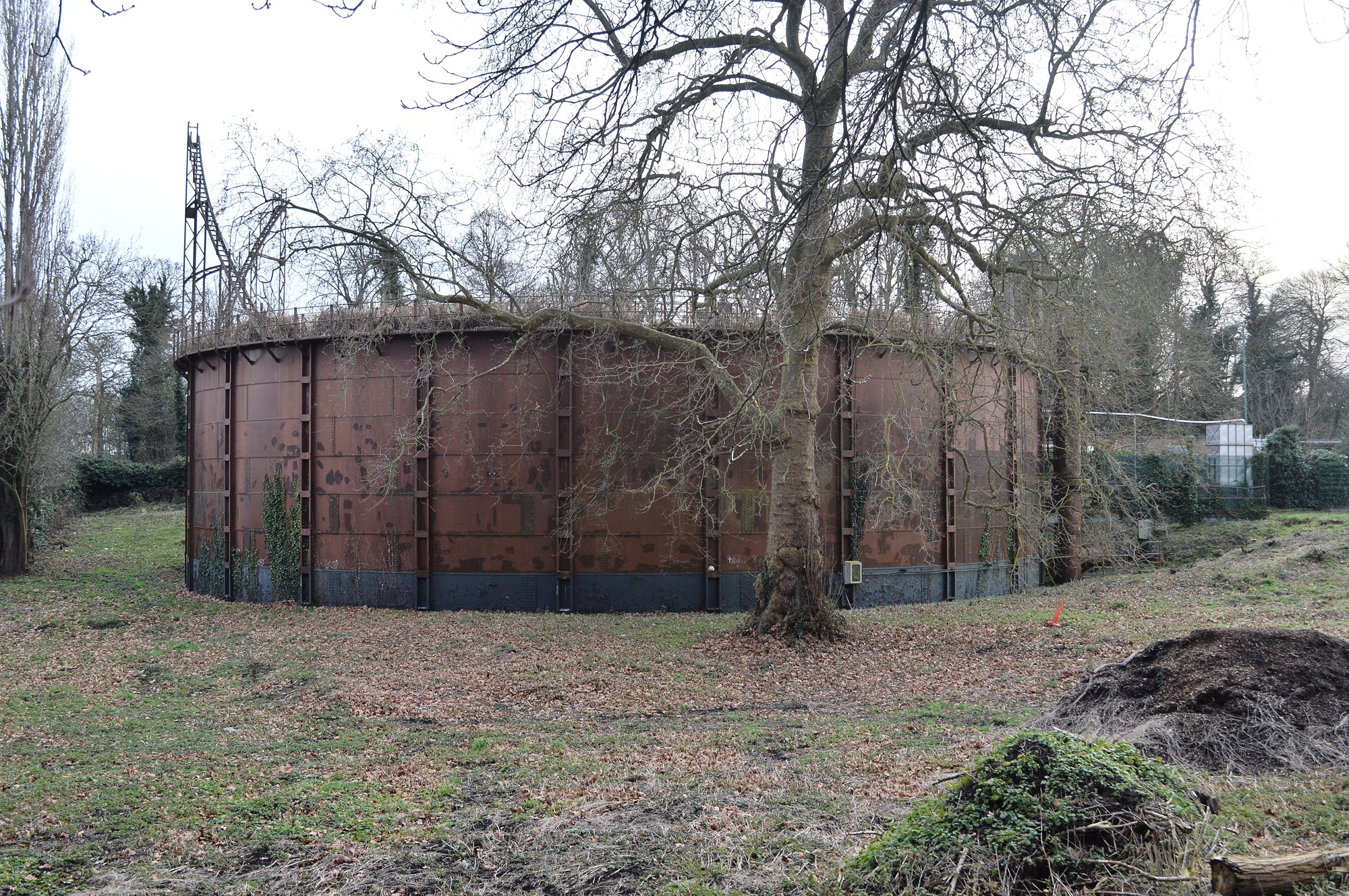
4. Crayford, LB Bexley. Two adjacent holders on a V-shape site at the junction of London and Old Roads. Despite its location some distance from river or rail for coal deliveries, a gas works was established here in 1852, acquired by the West Kent Gas Company in 1865. But the site has long been just a holder station. Plans exist for clearance and new residential properties, though a new small control facility will remain. A surrounding wall and already existing house block viewing ground level of the two holders from road level. The photographs, from Shenstone Park, are not possible when trees are in leaf.
a. No. 2. 1932 Rivetted steel guide frame, standing on an above-ground tank.
b. No. 3. 1955 spiral-guided holder with above-ground rivetted steel tank. Steps leading to nothing remain for access when the holder was up.
-
(Crayford No. 2, 5 Feb, 2025); (Crayford No. 3, 5 Feb, 2025)
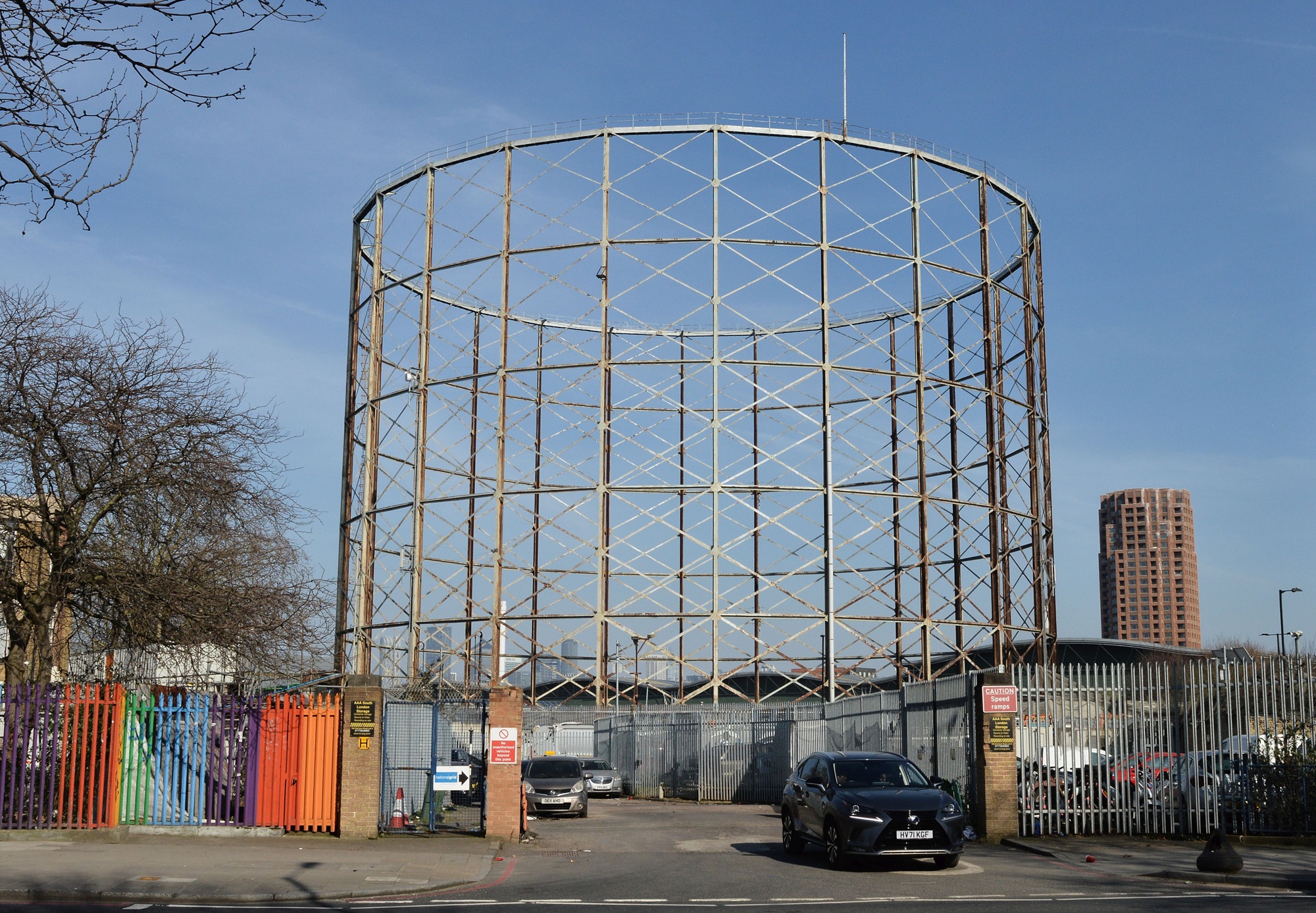
5. Old Kent Road, LB Southwark (opposite 682, Livesey Library). Holder No.13. Listed. Several years ago LB Southwark produced a plan for this to be a key feature of a new Livesey Park. But in April surrounding low-level industrial/warehousing buildings within the proposed park site remained in use.
-
(Old Kent Road, 29 March, 2025)
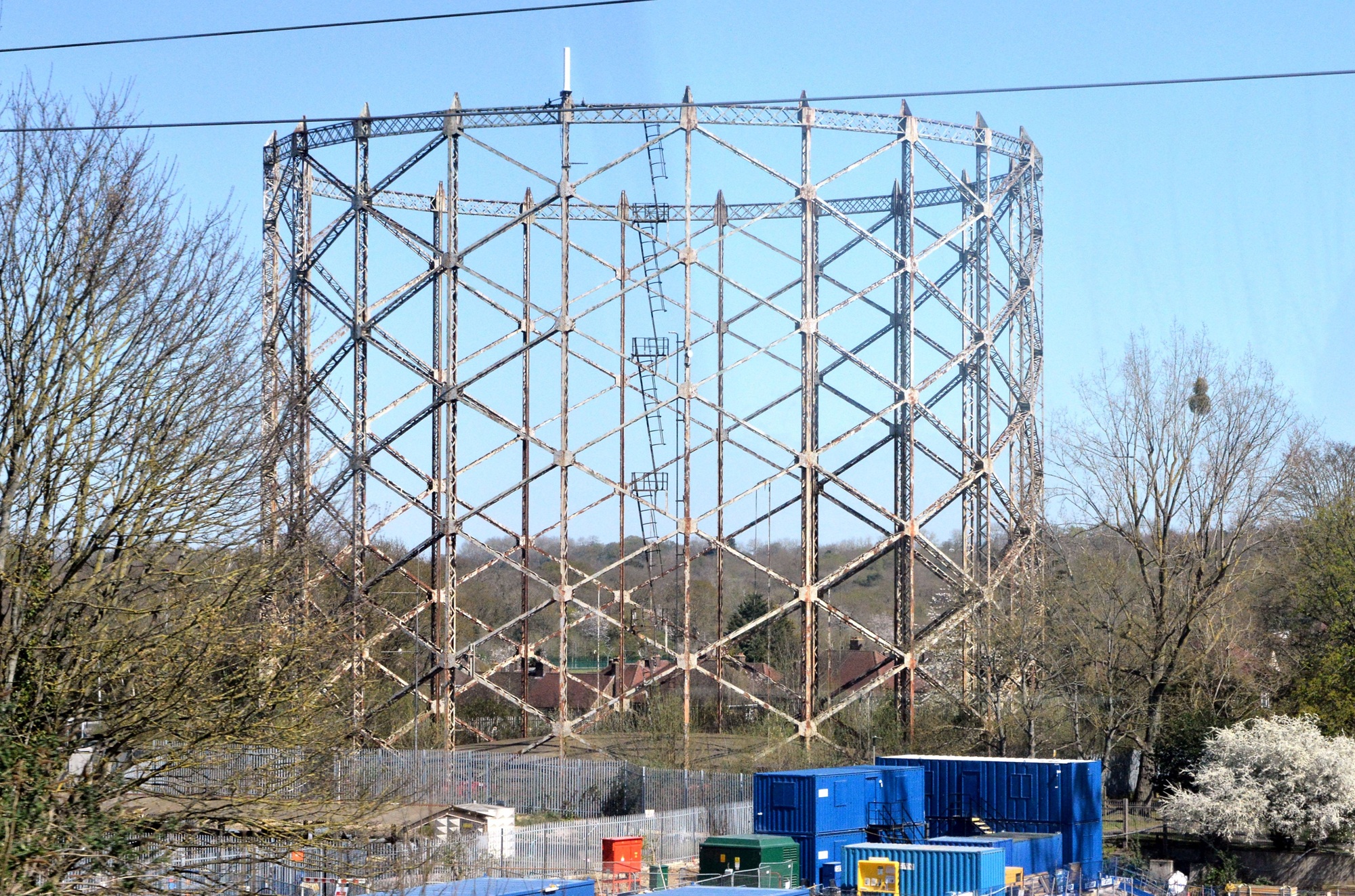
6. East Barnet, LB Barnet, north of Victoria Recreation Ground. A gas works is shown on an 1863 map, but only a single rivetted steel guide frame, 1934, for Barnet & District Gas and Water Company, remains. In April new housing was being built adjacent, but the frame itself was separately fenced off, although housing is planned for that site as well.
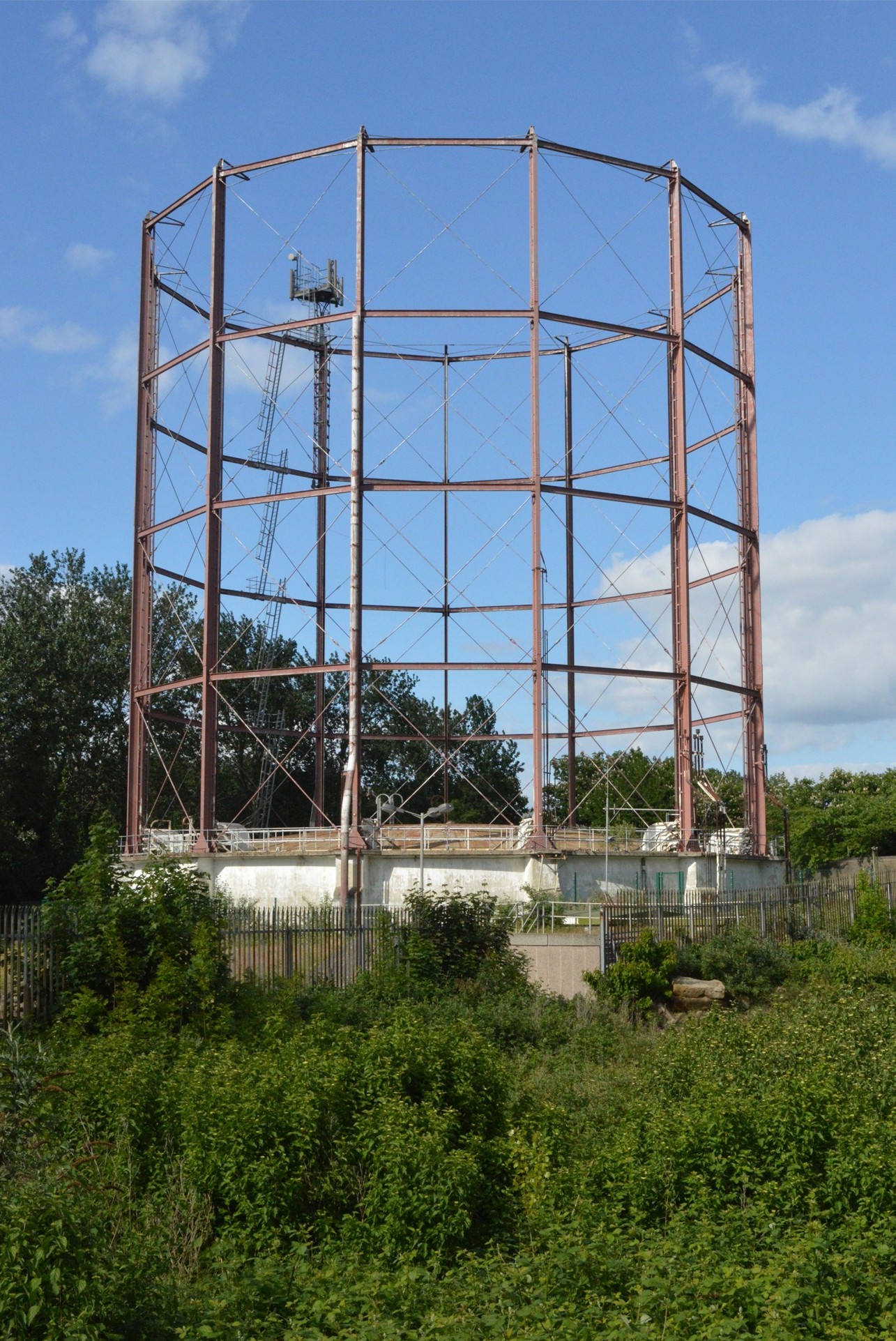
-
(East Barnet, from train, 12 April, 2025); (Rotherhithe, 5 May, 2025)
7. Rotherhithe, LB Southwark. Holder, No. 3 of 1935, stands alongside Brunel Road. Unlike the nearby Hydraulic Pumping Station, the works did not have a short tramway to convey coal from part of Surrey Docks, so cartage the short distance from a river pier seems likely.
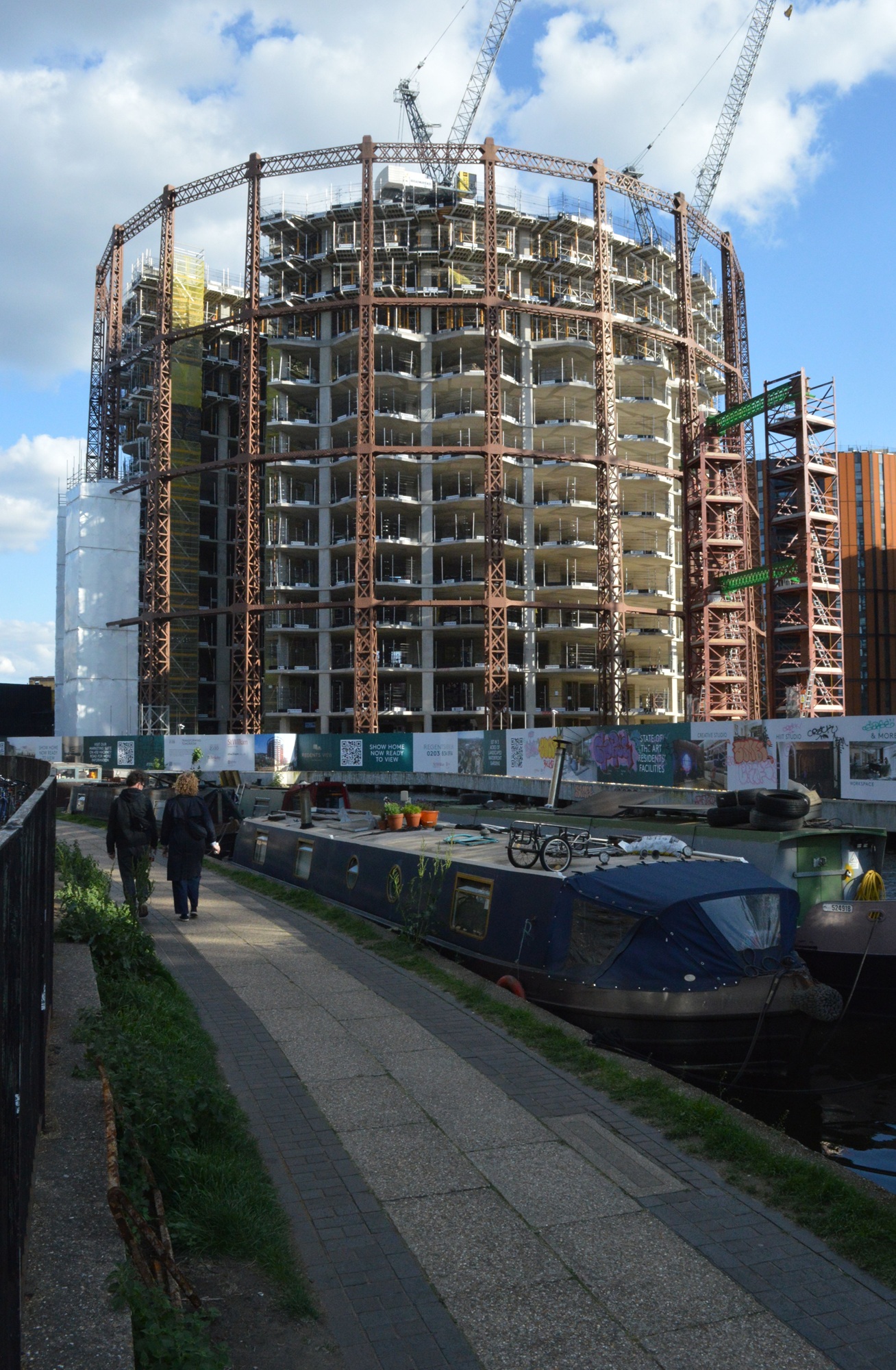
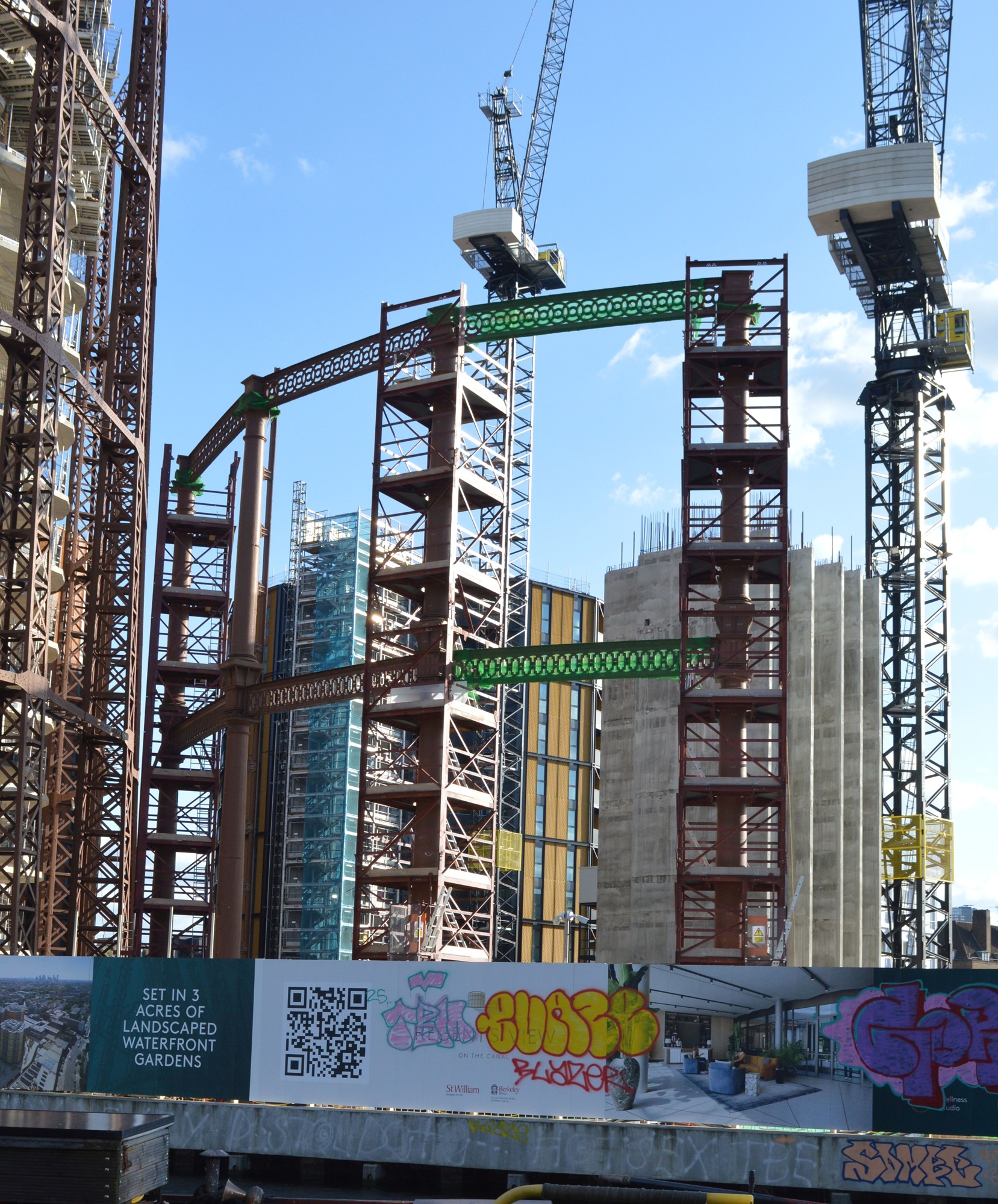
-
(Bethnal Green No. 5, 5 May, 2025); (Bethnal Green No. 2. 5 May, 2025)
8. Bethnal Green, LB Hackney. The Imperial Gas Light and Coke company acquired this canal-side site, just west of Cambridge Heath Road, in 1853. Despite the obvious ease of canal-side coal delivery it was only ever used as a holding station. Two adjacent holders remain of the five once here. Two new octagonal buildings are on the (approximate?) sites of former holders and in early May work was under way involving the remaining canal-side ones.
a. Holder No. 5, the largest, 1889, was, like the one at Kennington, being filled with new 'state of the art residential facilities' (hoarding proclamation), a.k.a. flats, though they appear to be in two half circle segments with a gap between.
b. Holder No. 2, 1866, had only a quarter standing, the rest having been dismantled for refurbishment and re-erection (as per King's Cross). It will also have residences built within.
Finally, Dan Hayton mentioned brick-enclosed gas holders in places of potential winter-time freezing, with a photograph of a fine example in Vienna. A pair of small octagonal ones of 1822, listed, survive alongside Saltisford (Road), Warwick, converted to housing. A grand pair were noted in Riga in 2009. David Thomas
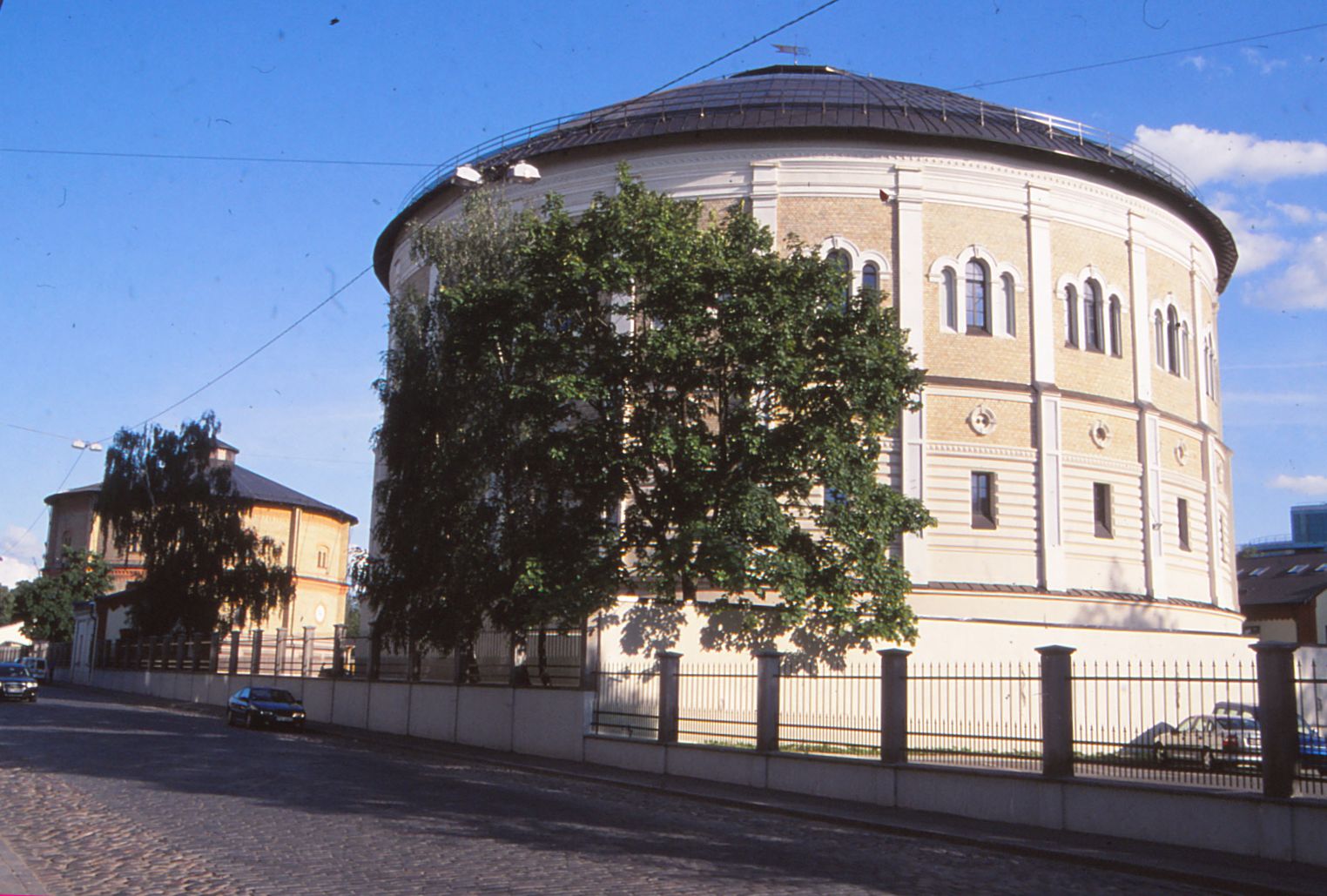
-
(7 July, 2009)
-
1. National Archives, Kew, item RAIL 274.160. A large map of London, circa 1935, showing ownerships of the four main line railway companies and of London Transport. Reader ticket, free, required.
Urea, also known as carbamide, is an organic compound of carbon, oxygen, nitrogen and hydrogen. The body uses it in many processes, particularly in nitrogen excretion. A colourless, odourless solid, it is highly soluble in water.
An important component of many fertilizers it is widely used by the chemical industry and is a raw material in the production of plastics, resins, and pharmaceuticals. It is used in cracked-heel repair cream and itch-relief cream.
In 1828 the German chemist Friedrich W öhler (1800-1882) synthesised urea from 'inorganic materials', demonstrating that organic and inorganic chemistry are in fact the same and discrediting the theory of vitalism *. On the 100th anniversary of Wöhler's death in 1982 the West German government issued a stamp depicting the structure of urea. Bob Carr
-
* It is now known that Wöhler's starting materials were not strictly inorganic but not long afterwards several other organic compounds were synthesised from inorganic materials by other chemists. Hermann Kolbe (1818-1884) synthesized acetic acid from the elements in 1845. Wöhler took an interest in meteorites and amassed a large collection. He noted that some meteorites contained organic matter.
Bob Carr's piece about Aberfeldy Street (GLIAS Newsletter April 2025) piqued my interest. A friend and I went there on Friday 4 April. It is a fascinating area — and Bob is right: its future is very much in doubt. Dave Hill's website OnLondon has much about the troubled development and its progress.
Go while you can. Nick at the Tommy Flowers is an amazing guy. His bar is clearly a major local hub welcoming anyone and everyone. We spent three hours there with a great selection of locals sharing life and experiences with them. It reminded us both of our limited experience of Glasgow's Gorbals and Manchester's Moss Side. A real community with real people open to anyone and everyone. Their various websites give a glimpse of some of the things they get up to!
The Tommy Flowers is a bar in what was once a florist and before that a doctor's. British History On-Line's East India Dock Road has much material about the area and Aberfeldy Street's place in it. Bob asks why the streets have Scottish connections. It goes back to Hugh McIntosh who is no doubt well known to GLIAS members as a Scottish civil engineer. After working with John Rennie on northern sites (including the Lancaster Canal) he moved south to work on building the London Docks and related waterways. Apparently he bought much land in the area from the East India Company and worked to drain the marshes there. The land seems to have been largely used for agricultural purposes. His son David McIntosh began to develop the site from about 1860 and built terraced housing for lease by building tradesmen and the like. No doubt, with his Scottish roots — and no doubt Scottish labour — the streets were named after places in Scotland.
So — although an enormous housing area — it has a very much industrial background both with Tommy Flowers himself and the McIntosh father and son.
With thanks to Bob and GLIAS for the introduction and to Nick Joubinaux owner of the pub (who says it is usually open Wednesday to Sunday from about 3). David Smith
The mid-15th century Upminster Tithe Barn had its roof re-thatched this winter. It was built circa 1450, at the beginning of the Wars of the Roses. This scheduled ancient monument was last re-thatched in the early 1960s and leaks had developed in the roof, putting it 'at risk'. Visits to the work in progress were arranged for members of the Society for Protection of Ancient Buildings.
With a length of 44 metres (144 feet), divided into nine bays, this is one of the longest thatched barns in England. The traditional long-straw thatch had to be stripped entirely and it was replaced with water reed imported from Turkey — recent poor harvests have reduced the supply of thatching straw. Four master thatchers and two apprentices were employed. Timber repairs were also undertaken, beneath the shelter of a temporary overall roof. Grants were obtained from Historic England and from the Highways Agency (responsible for the Lower Thames Crossing project, a new motorway from the M25 at North Ockendon to the M2 near Rochester).
The site's owners, Havering Council, now have work to do on sewerage and parking provision, to make it available for future community uses. It was not clear whether the previous tenant, the Museum of Nostalgia, would be able to return, although that originally agriculture-oriented museum, established in 1976, seemed well suited to the building's large but windowless interior space with only one entrance doorway. Malcolm Tucker
Going back in time just 29 years can remind one that not so long ago smoking on the bus was commonplace. Bob Carr

A Private Bill to close London's historic markets is currently going through parliament.
This law must be passed to shut down Smithfield (meat) and Billingsgate (fish) markets which were due to relocate to a new consolidated site beside the Thames at Dagenham Dock (GLIAS Newsletter 335, p11) until plans were shelved.
Existing operations at Billingsgate and Smithfield are due to continue until 2028.
Progress on the City of London (Markets) Bill can be found at https://bills.parliament.uk/bills/3896/publications
At Charlton, the decaying remains of the former Mersey Ferry, MV Royal Iris, have been on fire. There is a report in the local paper News Shopper and the Birkenhead News for 9 April 2025. Six fire engines, a fire boat, and about 40 firefighters from East Greenwich, Forest Hill, Poplar, New Cross, and Deptford were involved. The fire was brought under control by 7pm and an investigation is taking place. The photograph taken at Charlton about 2001 shows the stern of the ship when she was still afloat.
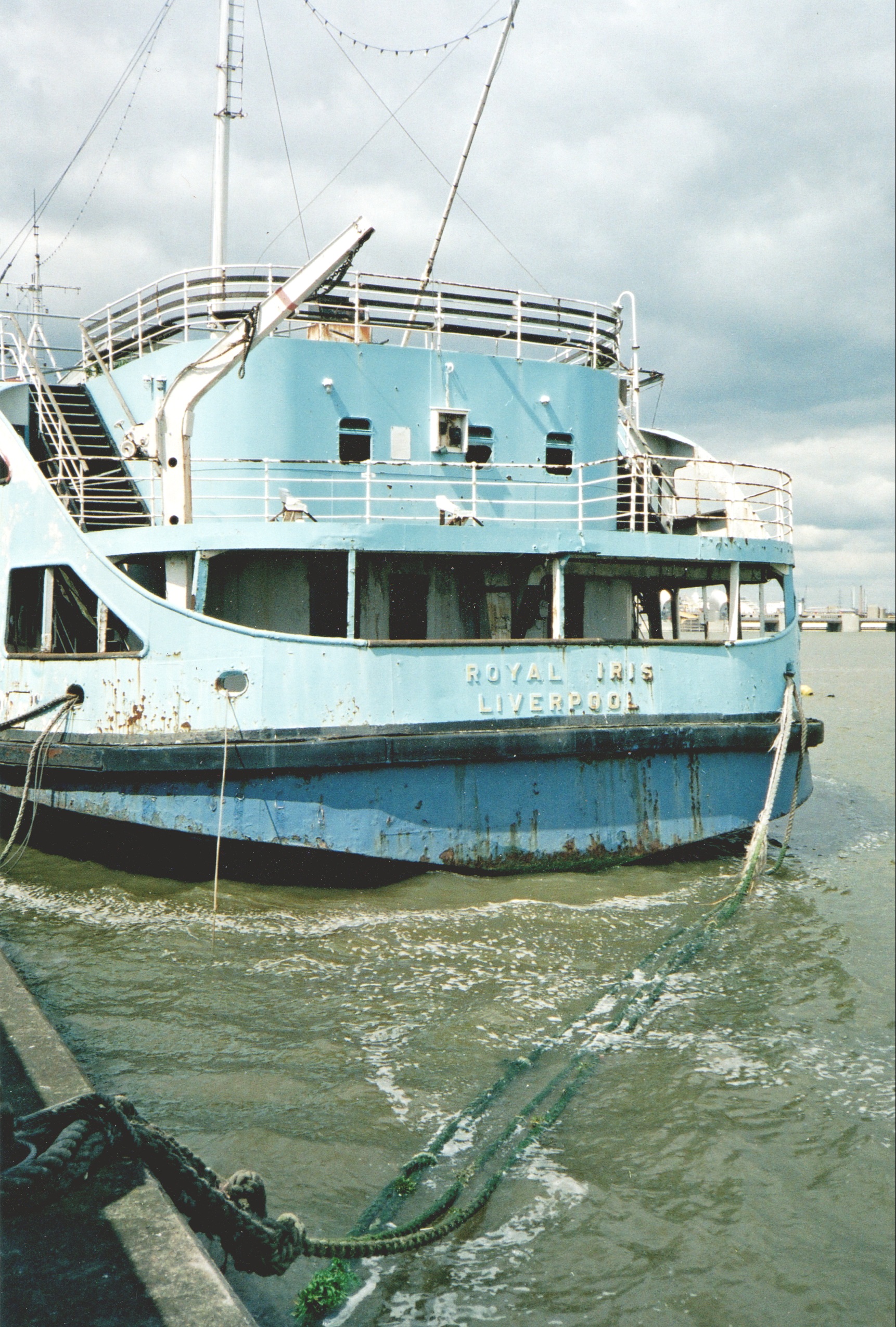
It is reported that the external appearance of the ship has not been greatly altered by the fire. Bob Carr
David Carpenter wrote a book, Dockland Apprentice, about his time working at a ship repair yard on the on the Isle of Dogs in the 1950s. He sent a note to the GLIAS Newsletter about getting his dirty overalls cleaned which was published last time; see GLIAS Newsletter April 2025.
David's book was reviewed in GLIAS Newsletter 212 (June 2004).
Dragon Rapide flights over central London continue to take place this year. One often flies over at about 12.00 to 12.30pm. Likely days are Wednesday, Friday and Saturday. It is quite easy to spot these slow-moving biplanes and they have a characteristic sound. It should be quite easy to take a photograph. Bob Carr

Docklands History Group's new identity
In November 2024 Docklands History Group members formally agreed to change the name of the group to the Thames and Docklands History Group — with the supportive strapline of London's River, Port and People.
As part of their Strategic Review, Trustees also approved a new logo and introduced a Quarterly Members' Newsletter in November 2024 and are in the process of developing a new website.
Their inaugural conference will be held at London Museum Docklands on 4 October, focusing on the post-1945 period.
Web: www.tdhg.org.uk
Derek Turner, who gave the April lecture on Milestones, writes to tell us of an interesting recent conservation project in Sutton.
Friends of Rose Hill Parks secured funding to refurbish the area around the milestone in Rose Hill Park and applied to Historic England to have it listed.
An original article about the history of five milestones (three from 1745 and two from 1755) in the London Borough of Sutton is in the Milestone Society Newsletter 40 pp38-41 (www.milestonesociety.co.uk/wp-content/uploads/2023/02/Milestone-Society-Newsletter-No-40-Winter-2021.pdf).
It was also discovered that two in the same 1745 set on Clapham Common had not been listed and Historic England rectified this. These are on Clapham Common South marking 4½ miles from Whitehall, and Clapham Common South marking 4 miles from Whitehall.
These milestones were erected in 1745 to mark the route from London Bridge to Banstead Downs for horse racing and there are eight surviving along this route through Stockwell, Clapham, Figges Marsh, Mitcham and Sutton. Later in the century, when the roads were hardened to take stage coaches, they marked the London to Brighton road.
Steelworks which have blast furnaces have been in the news recently. There is now only one example left in Britain which is at Scunthorpe in Lincolnshire, about 145 miles from London as the crow flies.
Following the closure of Ford's blast furnace at Dagenham, Corby in Northamptonshire, a straight line distance of about 73 miles away would have been the closest to London. Following the closure of Corby's blast furnaces, the steelworks at Dunkerque 108 miles away were then the nearest.
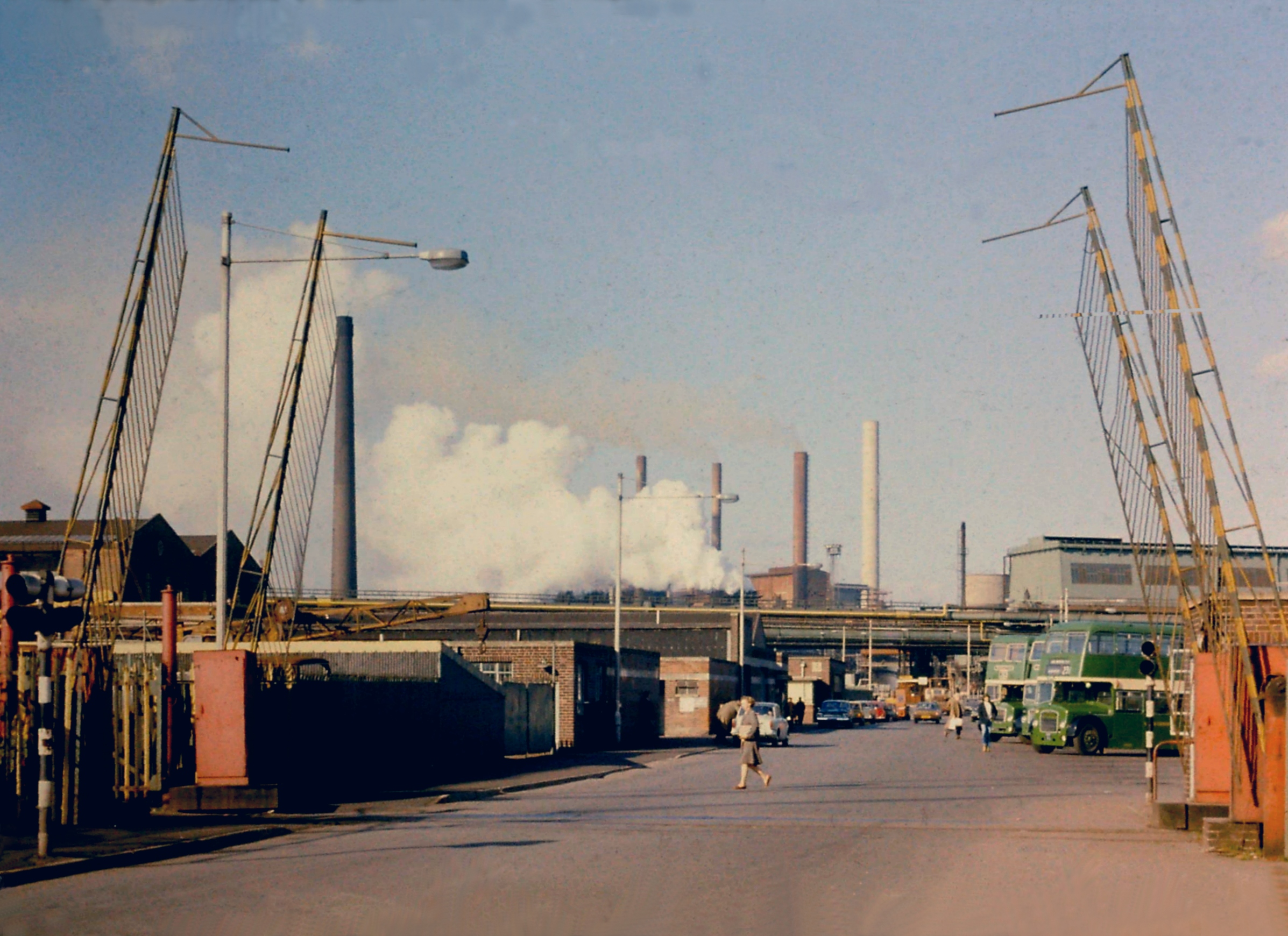
The photograph shows an entrance to Corby steelworks taken in October 1971.
The railway is electrified at 25 kV as far as Corby and 100 mph electric trains run to the town from London St Pancras in just over an hour. Corby is being promoted as a place for people to move to, and enjoy a better life. Bob Carr
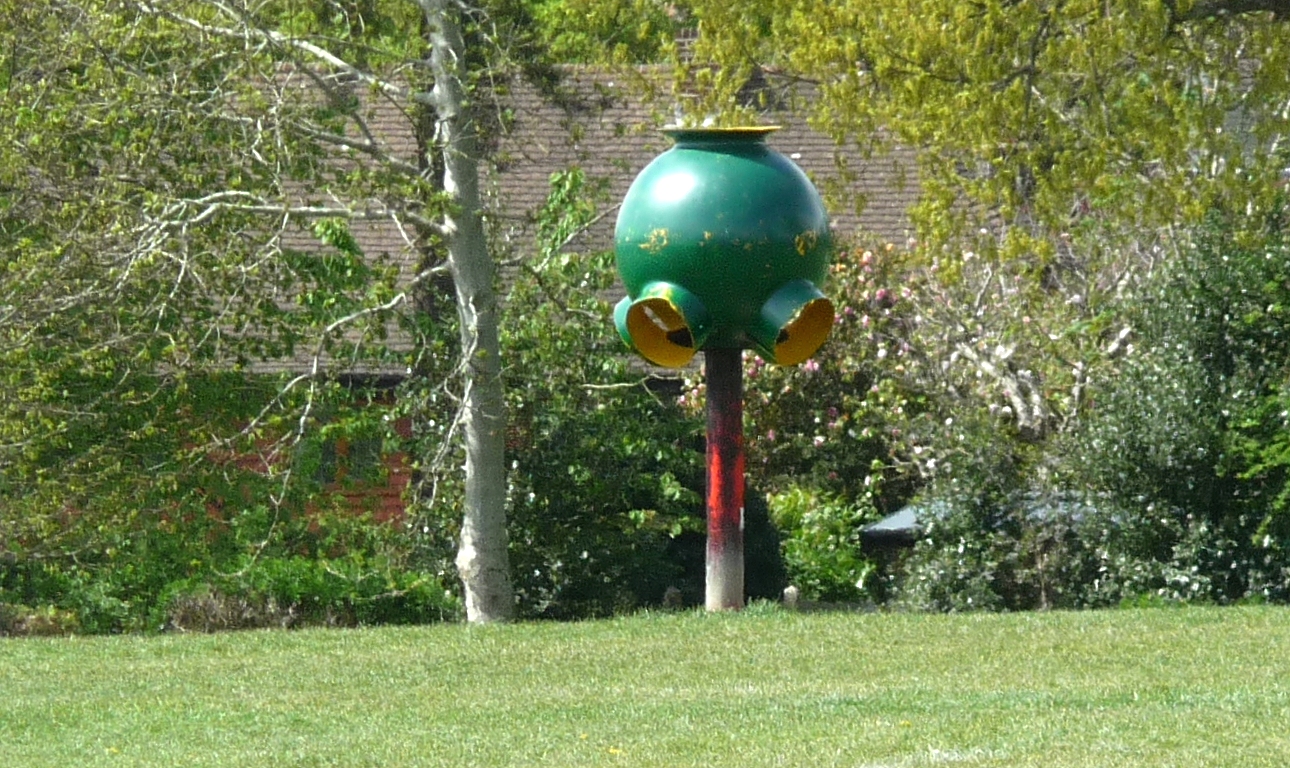
What is this mysterious object on a sports field at Oxted? It is about 8-12 feet high and looks like a water tower with a column. One suggestion is that is used for randomly distributing football or cricket balls. Bob Carr
This year marks the 50th anniversary of Neil Cossons' popular book, The BP Book of Industrial Archaeology, described in a GLIAS book review as 'the best book giving a general introduction to the subject'.

It is interesting to examine the book's gazetteer of sites in the UK to see which London sites were selected for special mention at the time. This was the list:
- Ram Brewery, Wandsworth (GTL00117)
- Kempton Park pumping station (GTL00195)
- Fournier Street silk weavers' houses (GTL00982)
- Water supply ponds, Islington (GTL00445)
- New River conduit (GTL00445)
- Kew Bridge water pumping station (GTL00115)
- Sewage pumping station, Greenwich (GTL00123)
- Abbey Mills sewage pumping station, West Ham (GTL00031)
- Crossness sewage pumping station (GTL00113)
- Webb sewer lamp, Carting Lane (GTL00911)
- Fulham Gasworks (GTL00172)
- Deptford power station (GTL00933)
- Kingsway tram subway (GTL00484)
- Camden Roundhouse (GTL00024)
- Hanwell Viaduct, Middlesex (GTL00479)
- Primrose Hill Tunnel (GTL00057)
- King's Cross Station (GTL00006)
- St Pancras Station (GTL00014)
- Tower Bridge (GTL00001)
- St Katharine Dock (GTL00253)
- Cutty Sark
The biggest change in these 50 years, though, is the ability to record industrial archaeology through computerisation, firstly via the personal computer and latterly through the internet and online databases. The GLIAS Database does not have to limit itself to a small selection of sites like Cossons' book; it can, and does, include everything from a small coal-hole cover to a revamped power station.
With AI rapidly approaching, will our database be built by artificial intelligence in the future? I hope not, but we need our members to contribute more, or else it might just be IA by AI before too long. Robert Mason
To get involved, or to get logon details, please contact us at database@glias.org.uk