by Peter Finch
Start Tower Gateway DLR, left to Tower Hill then across to East Smithfield.
ROYAL MINT, outside City of London boundary in Tower Hamlets, moved here from Tower of London in 1809, new buildings designed c1805 by James Johnson Mint's Surveyor, built 1807-12 by successor Sir Robert Smirke.
Main building was partially residential for officials, also bullion stores and Mint office. Behind minting machinery installed by Matthew Boulton and John Rennie. Mint moved to Wales between 1965 and 1975, then became offices and apartments.
Two lodges, high railings, former Seamen's Registry to the left, when converted excavations revealed remains of C14 Cistercian Abbey of St. Mary Graces. C16 Abbey land sold to Crown and became victualling yards for the Navy, until 1748 when they moved entirely to Deptford, then used as Government warehouses until demolished to make way for Mint.
2018 bought by People's Republic of China for a new embassy, commissioning David Chipperfield as architect, much local opposition but application before Tower Hamlets.

Go along East Smithfield down subway on left, continuing through it left to St. Katharine Dock.
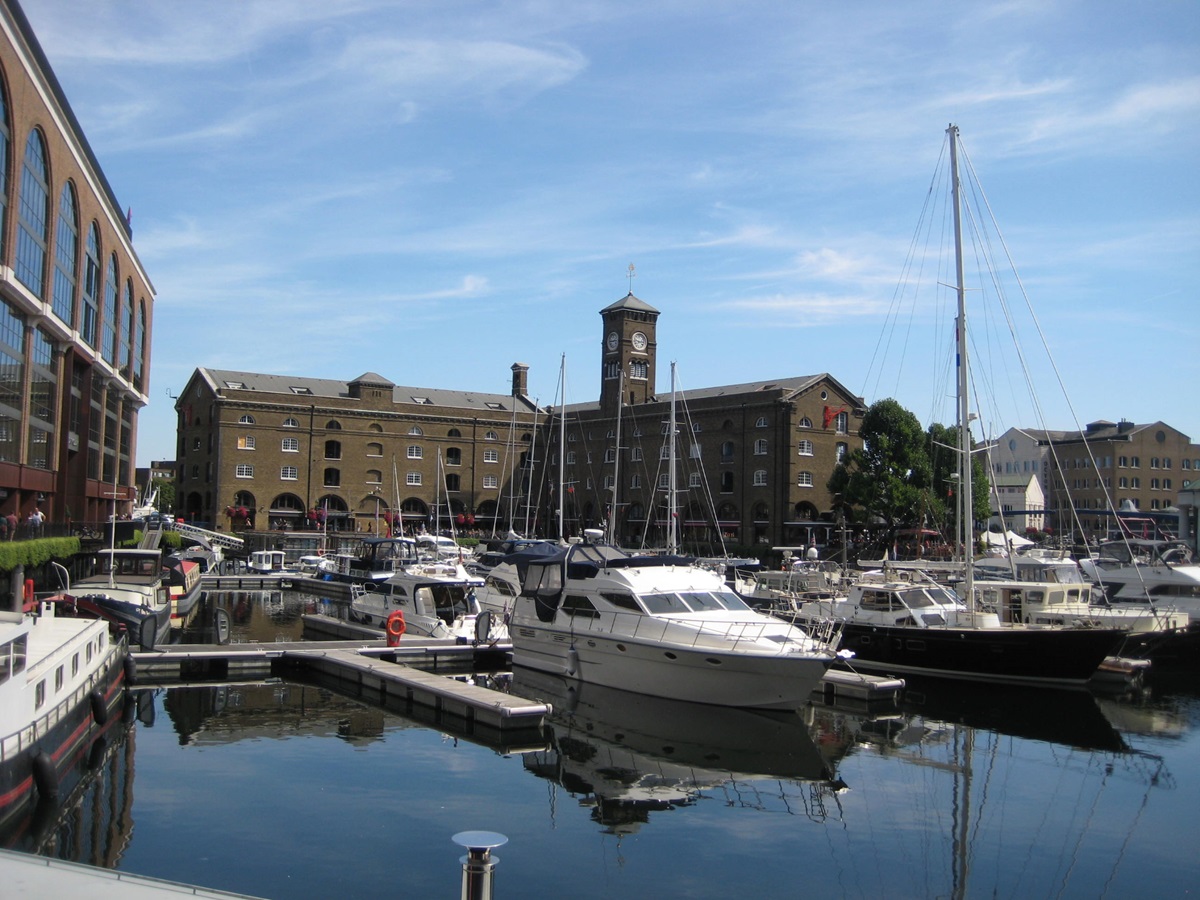
ST. KATHARINE DOCK — the smallest of the enclosed docks, the last of the early C19 wave of building, after West India, London, East India, Surrey & Regent's Canal docks. Built by St. Katharine Dock Co., consortium of seamen and City merchants, 1825-9 after the expiration of the monopoly granted to the London and West India Docks in the 1820s. On constricted site of the Foundation of St. Katharine, set up by Queen Matilda in 1147, a hospital, many houses, in a partially self-governing Liberty.


King George IV's wife Caroline was the Royal Patron until her divorce when she lost the role and the successor as Master eventually sold the land to the dock company, area then densely populated, over 1,000 houses demolished, compensation only to a minority, over 10,000 people evicted with no alternative accommodation.
The Foundation moved to Regent's Park, where the Swedish Church is now and then to Poplar and finally to Ratcliffe, near Limehouse Station.
Thomas Telford designed the docks, west and east, with a common entrance basin. His first dock commission, mainly manually dug with steam engine driving timber piling, spoil shipped to Pimlico to be used by Thomas Cubitt. Philip Hardwick (of Euston Arch fame) designed the warehouses, on cast iron columns on the very edge of the docks, cranes on the side of warehouses, unloading into covered areas, no need for transit sheds. No room for roads or railway lines, officially opened 25th October 1828. Warehouse unique in the London docks, six stacks surrounded and enclose the basins.
Because of restricted space from start pumping engines kept water levels, whereas most other docks had tidal basins until PLA in early C20 provided impounding stations and pumps.
Stop at edge of Western Dock.
South edge, recessed mooring rings. Original warehouses demolished and replaced 1970s/early 80s but retaining former warehouse Doric columns. Wall cranes retained. Thames sailing barges.

Walk along northern side of Western Dock, turn left at end up to entrance.
Dock wall runs along East Smithfield. Original vermiculated gate-piers, modern elephants.

Turn back to go along eastern side of dock.
I Warehouse or the Ivory House as it is now known, is the only warehouse still standing, designed in 1858 by George Aitchison, Hardwick's successor, replacing a wooden two-storey building. Wrought iron beams, cast-iron columns, largely open at ground level. Italianate tower. Cellars below.

Under warehouse, turn left.
Retracting footbridge 1829 at side is one of the earliest moveable iron bridges remaining in Britain. Thomas Rhodes, Resident Engineer, Millwright, John Lloyd, Westminster. Ballast in other section across bridge. Hand winch in situ. New hydraulic bridge 1994.

Dickens Inn — weatherboarded galleried exterior a fantasy, but structure genuinely old being part of the timber internal frame of an early warehouse pre-dating dock. Moved 55 metres to this site.

Entrance Basin — Recessed space for ship's bowsprit while waiting for tide, recessed rings.
Go around Entrance Basin cross modern lifting bridge.
Jigger demonstration crane, not currently working.

Entrance passage, 1970s hotel overdevelopment, from when dock closed 1968, GLC bought from PLA, competition won by Taylor Woodrow. Dockmaster's House other side, orig. cast-iron bollards marked St. Kats 1828. Gates 1957. From 1930s apart from ships of General Steam Navigation Co. goods barged in.


In Entrance Basin — Havengore, Tough's of Teddington, 1956 PL survey vessel, 1965 took Churchill's body upstream. Now privately owned.

Across basin — Coronarium — chapel to commemorate Silver Jubilee on supposed site of Royal Foundation's church, columns salvaged from A warehouse, on hotel site.
Go around entrance passage, turn right down St. Katharine's Way then left along Mews Street then along Eastern Dock.
Eastern Dock, warehouses destroyed WW2. St. Kats specialised in luxury goods — shells, feathers, ivory and tea, exporting wood. Finally closed 1968.
Walk around dock to exit on eastern side via entrance into Thomas More Street, then turn left.
LONDON DOCK — opened 1805, second enclosed after West India. Company obtained 21 year monopoly to deal with vessels trading in rice, tobacco, wine and brandy except those coming from the East and West Indies. Gradually expanded to 1858, from west to east until eventually comprising six docks stretching to Shadwell, 90 acres. First Western Dock, Daniel Asher Alexander, surveyor and architect and John Rennie civil engineer.
Main entrance with walls, flanked by dock offices designed by Daniel Asher Alexander.


Go through entrance and follow wall on right.
Sign on wall — Hydraulic valve.


Exit into Thomas More Street, Stockholm Way down to Wapping High Street.
1930s LCC St. Kats Estate.
More walls once up to 8 metres high now truncated enclosing end of Hermitage Basin by John Rennie 1811-21. Two sets of gate-piers with stalactite rustication used by Alexander throughout London Dock.
Former PLA Impounding Station 1913-14.


Riviera Court. Former hydraulic pumping station for dock company 1856.

Go into park.
Hermitage Memorial Gardens, for civilian victims of bombing in WW2.
Entrance with sandstone ashlar facings. Lock here once. Second entrance into Dock, closed 1909.


Turn round and go into Basin opposite.
Hermitage Basin named after a medieval retreat 'The Swan's Nest'.

Inner Entrance Lock, ashlar, with recesses shaped to 2 leaves of cast-iron swing bridge stolen 1976.
Steps in wall of former Western Dock, south side Rennie's quay wall, yellow stock brick with limestone rubbing band.

Former Wapping entrance basin and lock, massive curved sandstone walls, with bronze bust of Rennie by John Ravera. Pier Head best seen from the river.


Left along canal and then right at end.
Behind here and screened was News International, Fortress Wapping which shamefully replaced Alexander's North Stacks. NI 1986-2010. Now News UK at Shard block and prints various sites.
Replaced by new development which has preserved the Pennington Street Sheds.
Swing Bridge — c1912.

Tobacco Dock, formerly the New Tobacco Warehouse later known as the Skin Floor — built to link the original Western with new Eastern Dock. Alexander's huge warehouse, a bonded store for tobacco above wine and spirit vaults (fur and skins replacing tobacco later). Opened 1814, epitomises transition from timber buildings of C18 to iron-roofed structures of Victorian era. Built by Napoleonic prisoners of war.
Restored by Terry Farrell 1989, meant to be second Covent Garden, now events venue. Replicas 'Three Sisters' & 'Lark', type of vessels sailing here. Three Sisters built Blackwall, Sea Lark US.

Walk under road.
Eastern Dock — added 1824 -8, infilled post-closure, park called Wapping Wood. Quay walls, ventilation grilles. William Chapman engineer.

Shadwell Basin — final extension east. Garnet Street steel lifting bridge of Scherzer rolling bascule type 1930s restored by LDDC. Present basin is New SB 1854-8 by JM Rendel, south side Old SB 1828 32 by HR Palmer.


Turn right and walk around basin, exiting on Glamis Road.
Former Lifting Bridge, Glamis Road. Water tank counterbalance. High enough for double decker bus.

Lock, sailing centre, school. Circular deck. London Docks closed 1968.


ST. PAUL'S CHURCH — rebuilt 1821 replacing C17 chapel, John Walters architect.
WAPPING HYDRAULIC PUMPING STATION — 1889-93, boilers and engines, last working station of five built by London Hydraulic Power Co. to provide power for cranes, lifting bridges etc. Closed 1977, steam and electric from 1950s, water from Basin, later a well, filtered, passed by gravity to underground reservoir then pumped to mains. Tower — 2 accumulators.
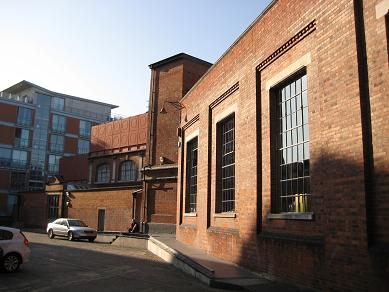

Engineer's House.

Finish at Prospect of Whitby public house.
